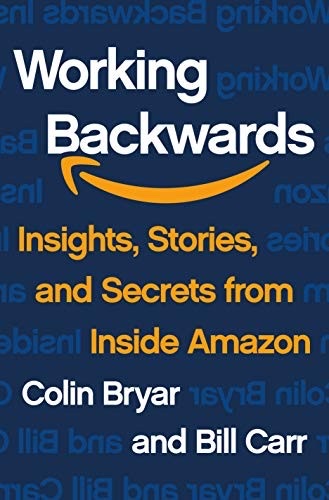
Cover of Working Backwards: Insights, Stories, and Secrets from Inside Amazon

Working Backwards: Insights, Stories, and Secrets from Inside Amazon

Colin Bryar, Bill Carr

6 ideas

  1. Narratives Replace PowerPoint in Decision Meetings

    Meetings begin with 20-30 minutes of silent reading of a six-page narrative memo before any discussion. Writing prose forces logical rigor that bullet points hide, and silent reading ensures everyone engages with the full argument rather than reacting to a presenter's delivery.

  2. Working Backwards from the Press Release

    Before building a product, write the press release and FAQ as if it has already launched, describing the customer benefit in plain language. If you cannot write a compelling press release, the product isn't worth building — the document becomes the test of whether the idea matters to customers.

  3. Single-Threaded Leader for Each Initiative

    Every important initiative gets one leader whose sole job is that initiative, with no competing priorities dividing their attention. Dependencies and divided ownership are the primary cause of slow execution, so isolating accountability to one undistracted person accelerates progress.

  4. Input Metrics Over Output Metrics

    Teams should manage controllable input metrics — like selection, price, and in-stock rate — rather than fixating on output metrics like revenue or stock price that they cannot directly move. Improving the right inputs reliably produces the desired outputs over time, so attention belongs upstream.

  5. Two-Pizza Teams Reduce Coordination Cost

    Teams should be small enough to be fed by two pizzas, because communication overhead grows non-linearly as teams enlarge. Small autonomous teams that own their entire stack move faster than large teams burdened by internal coordination and cross-dependencies.

  6. Mechanisms Beat Good Intentions

    Good intentions don't work; only mechanisms do — a complete process with tools, adoption, inspection, and reinforcement that survives turnover and forgetting. When something repeatedly fails, the answer is to build a self-correcting system rather than to ask people to try harder.

Save and mark ideas in the app