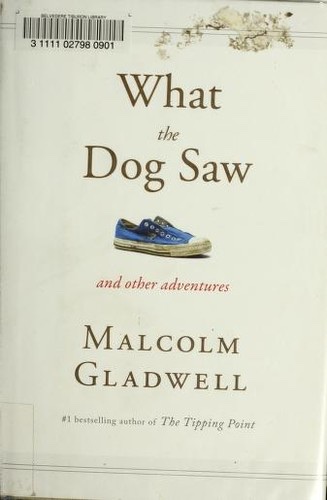
Cover of What the Dog Saw

What the Dog Saw

Malcolm Gladwell

6 ideas

  1. The Dog's-Eye View of Expertise

    Instead of asking why people behave a certain way, ask what the situation looks like from the perspective of the thing being observed — what the dog saw, not what the trainer intended. This shift relocates the source of behavior from internal character to the structure of the immediate environment as perceived from the inside.

  2. Mysteries Versus Puzzles

    A puzzle is solved by acquiring more information that is currently hidden, while a mystery cannot be solved by more data — it requires better interpretation of information already overwhelming in supply. Treating a mystery like a puzzle leads to demands for more facts when the actual failure is one of analysis and judgment.

  3. Late Bloomers Need Sustained Patronage

    Some creators produce their best work only after decades of experimental, exploratory effort, unlike prodigies who arrive fully formed. Because their value is invisible early on, late bloomers depend on a patron who funds and believes in them through long unproductive stretches that conventional metrics would abandon.

  4. Choking Versus Panicking

    Choking is performing worse because you start thinking explicitly about a skill that should be automatic, regressing to a beginner's conscious control. Panicking is the opposite — reverting to instinct and losing access to learned knowledge; the two failures look identical from outside but require opposite remedies.

  5. Ketchup's Single Perfect Formula

    While mustard splintered into dozens of varieties matched to different taste clusters, ketchup resisted segmentation because its formula hits all five basic tastes simultaneously in a balance most palates already accept as ideal. This illustrates that some products genuinely have one optimum while others have no single best — only multiple bests for multiple people.

  6. Profiling Is Pseudoscientific Hindsight

    Criminal profiles work like cold readings: they offer statements vague and contradictory enough that almost any eventual suspect can be made to fit them retroactively. The perceived accuracy comes from selective memory of hits and the broadness of predictions, not from genuine predictive power.

Save and mark ideas in the app