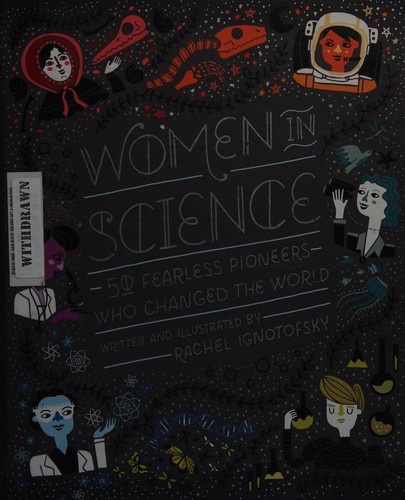
Cover of Women in Science

Women in Science

Rachel Ignotofsky

5 ideas

  1. Rosalind Franklin and Photo 51

    In 1952 Rosalind Franklin's lab at King's College London produced Photo 51, an X-ray diffraction image that clearly showed DNA's helical structure. Maurice Wilkins showed it to James Watson without her knowledge, and it helped Watson and Crick build their double-helix model.

  2. Credit flows to the credentialed collaborator

    When a woman did the key interpretive or experimental work inside a team, recognition tended to go to the male colleague who held the institutional position. Lise Meitner gave the physical explanation of nuclear fission, but Otto Hahn alone received the 1944 Nobel in Chemistry. Chien-Shiung Wu's 1956 experiment confirmed that parity is violated, yet the 1957 physics prize went only to the theorists Lee and Yang.

  3. Low-status labor as discovery site

    Work classed as clerical or routine was where women were allowed in, and it was sometimes where foundational discoveries happened. Henrietta Leavitt was hired at Harvard Observatory as a low-paid 'computer' cataloging stars on photographic plates. From that work she found the period-luminosity relationship of Cepheid variable stars, which became the yardstick for measuring cosmic distances.

  4. Exclusion forced science through side doors

    Barred from universities, degrees, and paid posts, women entered science through the channels that stayed open. These channels were family households, self-funded expeditions, artistic training, and assistant roles.

  5. McClintock's jumping genes vindicated decades later

    Studying maize, Barbara McClintock found in the 1940s that genetic elements can move within a chromosome and switch other genes on and off. Colleagues largely dismissed or ignored the finding, and she eventually stopped publishing it widely. Molecular biology later confirmed transposons, and she received an unshared Nobel Prize in Physiology or Medicine in 1983.

Save and mark ideas in the app