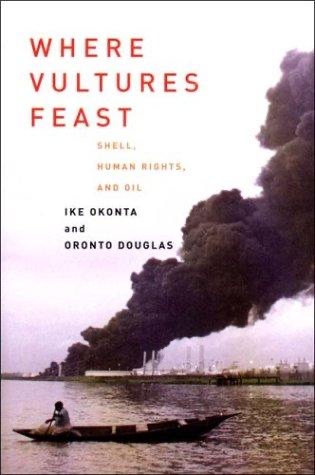
Cover of Where Vultures Feast

Where Vultures Feast

Ike Okonta and Oronto Douglas

6 ideas

  1. Oil company and military state as partners

    The book argues that Shell and Nigeria's military governments were joint operators, not a firm working under a separate sovereign. The state held majority equity through the joint venture and relied on oil rents to survive. The company relied on state security forces to protect installations and suppress dissent, so each partner's survival depended on the other.

  2. Double standards in multinational environmental practice

    Multinationals run far weaker safety and environmental practices where regulation and local political power are weak. The authors treat this gap as a deliberate cost-saving choice that shifts costs onto people with little political power.

  3. Blaming spills on sabotage as liability deflection

    When a company classifies spills as sabotage, it avoids compensation duties and turns the victims into suspects. The authors read Shell's sabotage attributions as a strategic narrative, not neutral technical findings. Their tests are who investigates, who benefits from the classification, and whether corroded infrastructure is ignored.

  4. The Ogoni uprising and Saro-Wiwa's execution

    The Movement for the Survival of the Ogoni People (MOSOP), led by Ken Saro-Wiwa, mobilized mass nonviolent protest demanding environmental remediation, a share of oil revenue and political autonomy. By 1993 the protests had forced Shell out of Ogoniland. The Abacha regime answered with military occupation of Ogoni villages and a tribunal that hanged Saro-Wiwa and eight others in 1995, showing how far a petro-state will go to keep oil flowing.

  5. Resource wealth impoverishes its host communities

    The Delta's minority communities sit on the oil that funds the Nigerian federation, yet they live without clean water, electricity or intact farmland and fishing grounds. Revenue-allocation rules and federal ownership of subsoil resources move the wealth to the center and to foreign shareholders. Pollution destroys the local subsistence economy, so extraction leaves host communities poorer than before.

  6. Divide-and-rule through selective community payments

    The authors describe a pattern of targeted payouts to chiefs, youth factions and contractors. This fractures community opposition and turns neighbors into rivals over company money. The resulting intra-communal conflict is then cited as proof that the region is unstable and needs a security response.

Save and mark ideas in the app