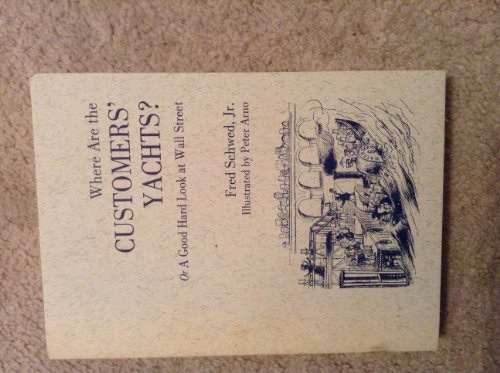
Cover of Where Are the Customers' Yachts?

Where Are the Customers' Yachts?

Fred Schwed

6 ideas

  1. The Customers' Yachts at Newport

    A visitor to New York is shown the bankers' and brokers' yachts anchored in the harbor and asks innocently, "But where are the customers' yachts?" The joke captures how the financial industry works: the people who handle other people's money reliably get rich from fees and commissions, whether or not their clients do.

  2. Coin-Flipping Contest Produces False Champions

    If a large crowd plays a coin-tossing contest and the losers drop out each round, a few people will win many times in a row by chance alone. Those survivors will be praised as skilled and will come to believe it themselves, even though the contest had no skill in it. Celebrated investment managers can arise the same way, and their track records alone cannot prove they are skilled.

  3. Nobody Can Reliably Forecast Market Prices

    Wall Street sells predictions of market direction with great confidence, but no one has shown a lasting ability to forecast prices. Forecasters survive because correct calls are remembered and advertised while wrong calls are quietly forgotten. Any forecast is also hedged enough to be defended afterward, whatever happens.

  4. Brokers Profit from Activity, Not Results

    A broker is paid on each transaction, so his income depends on how often the customer trades, not on whether the customer makes money. Seen this way, a great deal of "advice" is really a reason to trade, and constant portfolio churning is the business model rather than a mistake.

  5. Speculation Disguised as Investment

    Speculation is an honest attempt to turn a little money into a lot, knowing you will probably lose. Investment is an attempt to keep a lot of money from turning into a little. The danger comes when people speculate while calling it investing, because the label hides the risk and makes reckless bets seem prudent.

  6. Earnest Advisers Believe Their Own Nonsense

    The main failing of Wall Street is not fraud but sincere self-deception. Advisers really believe they have insight, because they have been rewarded in rising markets and their shared jargon makes them sound expert to each other. Clients are therefore misled more by honest confidence than by deliberate lies, which makes the problem harder to detect.

Save and mark ideas in the app