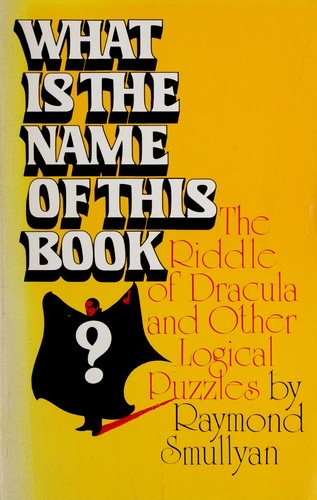
Cover of What Is the Name of This Book?

What Is the Name of This Book?

Raymond Smullyan

3 ideas

  1. Case-splitting on knight or knave identity

    To solve a truth-teller/liar puzzle, assume each speaker is a knight (statement true) and then a knave (statement false), and keep only the assumptions that don't produce a contradiction. A knight's statement and its truth are equivalent, so 'X says P' becomes 'X is a knight if and only if P,' turning riddles into mechanical propositional logic.

  2. Self-reference statements no inhabitant can utter

    Some sentences are impossible for anyone on a knights-and-knaves island to say: 'I am a knave' can't come from a knight (it would be false) or a knave (it would be true). Such a sentence's impossibility is itself information, and the same self-referential structure is behind the liar paradox.

  3. Truth outruns provability in consistent systems

    Consider a sentence that asserts 'I am not provable' within a system that proves only true things. If the system proved it, it would prove a falsehood, so the sentence is unprovable and therefore true. The book reaches this by recasting the knight's 'I am not a knight' as a sentence about provability.

Save and mark ideas in the app