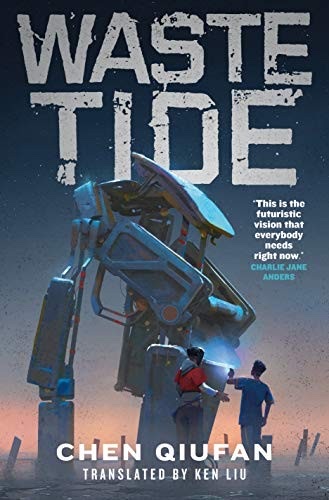
Cover of Waste Tide

Waste Tide

China · 2013–2033

4 ideas

Buy on Amazon

On near-future Silicon Isle in southern China, migrant workers take apart the world’s discarded electronics. Among them is Mimi, caught in a toxic trade shaped by local clans and outside investors. Chen Qiufan’s science fiction novel follows the people who handle that waste and the powers that profit from it.

  1. Silicon Isle's waste economy and Mimi

    On Silicon Isle, a thinly fictionalised Guiyu, three native clans (Luo, Chen and Lin) control a trade in which migrant 'waste people' strip imported electronics by burning circuit boards and dissolving chips in acid for metals, while the air and water turn toxic. American executive Scott Brandle of TerraGreen Recycling arrives with interpreter Chen Kaizong, a native son raised abroad, to pitch a 'green' recycling park that also covers a search for a dangerous lost object. Mimi, a waste girl, is infected through scavenged waste, brutally beaten by clan enforcers, and only then emerges as a split, posthuman consciousness able to command machines, turning the waste people's revolt during a typhoon.

  2. Global consumption exports its toxicity downstream

    The novel argues that the lifecycle cost of cheap electronics is not destroyed but relocated. Rich-world consumers discard devices, and the poisoning of air, water and bodies is shipped to a peripheral town where it is paid for in the lungs and skin of workers who never owned the goods. Pollution here is presented as a transfer of harm along a supply chain, not an accident of bad local management.

  3. Waste people as a tiered underclass

    Silicon Isle's hierarchy has three layers. Native clans act as rentier bosses who own the trade and the land. Migrant 'waste people' from poorer provinces do the toxic labor without local standing or protection. Foreign capital sits above both, using the language of green development. Exploitation runs through each layer, so outsiders' reform rhetoric and locals' clan loyalty both leave the waste people at the bottom.

  4. The posthuman as byproduct of dystopia

    Read the book first as a dystopia of Guiyu. On this reading the new being is manufactured by the waste stream itself: infection, violence and discarded technology produce her. The novel's speculative leap is therefore a consequence of material exploitation, not an escape from it.

Save ideas and give them a thumbs up or down in the app