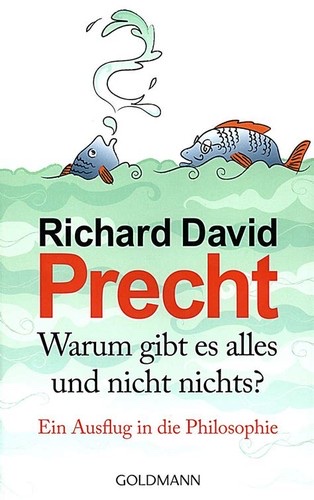
Cover of Warum gibt es alles und nicht nichts?

Warum gibt es alles und nicht nichts?

Richard David Precht

4 ideas

  1. Philosophy taught through Berlin walks

    Each place supplies the question: watching animals at the zoo raises whether animals think and feel, the Natural History Museum raises where the world and life came from, and the synagogue raises whether God exists. The case shows abstract philosophy taught to a child by anchoring each problem in a concrete physical encounter instead of a syllabus of thinkers.

  2. Children's why-questions are real philosophy

    A child's naive question, such as why there is anything at all rather than nothing, is treated as a real philosophical problem and not as something to correct. Such questions often have no final answer. Their value is that they train a person to notice what is puzzling about things everyone else takes for granted.

  3. Animal minds differ by degree, not kind

    Humans and animals are not separated by a sharp line where mind begins. Evolution produces a gradient of perception, feeling and intelligence, which is especially visible in great apes. If animals can feel and suffer, the boundary we draw between creatures deserving moral concern and mere things is a human convention that needs justification.

  4. God lies beyond proof and disproof

    The existence of God cannot be settled by evidence or logical argument in either direction, because God, if real, lies outside what experience can test. Belief therefore belongs to faith rather than knowledge. The honest philosophical stance is to separate what we can know from what we choose to believe, not to claim certainty for either side.

Save and mark ideas in the app