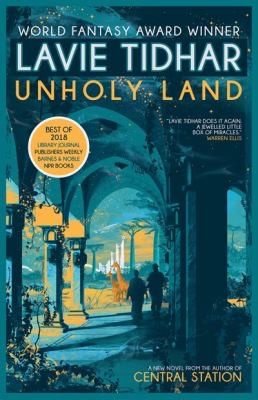
Cover of Unholy Land

Unholy Land

Lavie Tidhar

3 ideas

  1. A Jewish State Founded in East Africa

    In this alternate history, the Zionist movement accepted Britain's early-1900s offer of territory in East Africa, and the state of Palestina grew there instead of in the Middle East. Pulp novelist Lior Tirosh returns to its capital from abroad and is pulled into a murder, a state security investigation, and a country building a separation wall against the displaced Africans at its edges. The case lets readers ask whether Israel's conflicts come from its particular land or from the nation-building project itself.

  2. Displaced Geography Makes Familiar Politics Visible

    Moving a charged political situation into an unfamiliar setting strips away the reader's inherited loyalties and prepared arguments. A wall in East Africa against Africans cannot be defended by habit, so its function as exclusion becomes plain. Alternate history works here as a defamiliarization device: the reader judges the structure before recognizing it as their own.

  3. Walls Between Nations Mirror Walls Between Worlds

    The novel treats the physical border wall and the boundaries between parallel realities as the same kind of membrane. Each separates a group from other versions of itself and from the people it excluded. As Tirosh slips between versions of the Jewish state, the other possible histories show that his country is one contingent choice among many, and so it could have been otherwise.

Save and mark ideas in the app