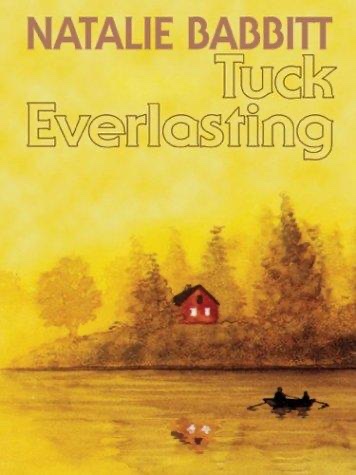
Cover of Tuck Everlasting

Tuck Everlasting

Natalie Babbitt

4 ideas

  1. Winnie Foster and the Tuck spring

    Ten-year-old Winnie Foster finds Jesse Tuck drinking from a hidden spring in her family's wood in Treegap and learns that the Tucks stopped aging 87 years earlier after drinking from it. When a man in a yellow suit plots to sell the water, Mae Tuck kills him to protect the secret. Winnie helps Mae escape the gallows, and Jesse gives her a bottle of the water to drink at seventeen so she can marry him. In the epilogue the Tucks come back to find her gravestone: she lived a full life, married, and died in 1948, having poured the water on a toad instead.

  2. Immortality removes a person from life's wheel

    Angus Tuck argues that life works like a wheel or a flowing pond, where everything moves, changes, and gives way to what comes next, and death is part of that motion. A person who cannot die does not gain more life. They are stranded beside it like a rock at the edge of a stream, watching things move past without being part of them. On this view mortality is the condition for being alive, not a limit on it.

  3. Timelessness strips action of consequence

    Each family member copes differently. Jesse drifts through pleasures, Miles grieves the wife and children who aged and left, and Tuck wishes he could grow. The lens is this: when time never runs out, choices lose their weight, because nothing is ever urgent or final.

  4. Commodifying eternal life as moral corruption

    The man in the yellow suit wants to buy the Fosters' wood and sell the spring water only to people he judges worthy. That would turn endless life into a product that concentrates power and upsets the natural order. The book treats this as the worst misuse of immortality: extending life for profit makes a dangerous secret into a market, and the danger grows with every buyer.

Save and mark ideas in the app