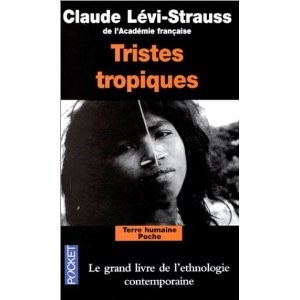
Cover of Tristes Tropiques

Tristes Tropiques

Claude Lévi-Strauss

4 ideas

  1. The Nambikwara chief's writing lesson

    Lévi-Strauss handed out paper and pencils to the Nambikwara of western Brazil, who could not write. Their chief began drawing wavy lines, then at a gift exchange pretended to 'read' from his sheet a list of what the anthropologist would give each man, using the imitation of writing to raise his own authority over his followers. From this episode Lévi-Strauss argued that writing's primary historical function was not to spread knowledge but to enable the domination and enslavement of people by a literate few.

  2. Missionaries dismantling the Bororo circular village

    The Bororo village was a circle of huts around a central men's house, divided into moieties and clans whose positions laid out kinship, marriage rules and ritual duties on the ground itself. Salesian missionaries found that the surest way to convert the Bororo was to move them into villages of houses in parallel rows. Stripped of the spatial layout that encoded their social order, the Bororo lost their bearings in their own social and religious system and became easier to convert.

  3. The traveller always arrives too late

    The explorer seeking untouched cultures faces a double bind. If he travels now, he finds only the debris of societies already damaged by the West and pines for the authentic past. Had he travelled earlier, he would have lacked the framework to understand what he saw and would have missed what later observers will value. Travel writing that sells exotic authenticity is therefore a fraud: it sells the reader the illusion of a diversity that the traveller's own civilisation is destroying.

  4. Entropology: humanity as a force of disorder

    Lévi-Strauss proposes renaming anthropology 'entropology', the study of how human activity breaks down highly organised, differentiated structures into an ever more uniform inertia. On this view civilisation, especially the Western civilising project, is less a march of progress than a machine that flattens cultural diversity into sameness. The ethnographer ends up recording a process of disintegration that his own presence helps speed up.

Save and mark ideas in the app