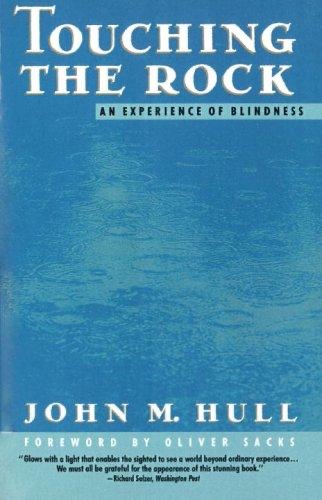
Cover of Touching the Rock

Touching the Rock

John Hull

4 ideas

  1. Rain restores the blind man's world

    Hull, fully blind by 1983, records sitting at an open door listening to rain falling on the garden and finding that the whole scene suddenly exists again: the lawn, the path, the bushes and the fence each give off a different sound, so the space takes on contour, distance and texture. In silence the blind person's world shrinks to what can be touched, but a continuous sound spread over everything lets hearing do what light does, and he wishes it would rain indoors so that rooms would reappear too.

  2. Deep blindness as loss of visual memory

    After several years without sight, Hull finds he can no longer picture his wife's or children's faces, or even imagine what a number looks like. He calls this state 'deep blindness': the eyes have failed, and the mind has also stopped thinking in images and reorganized itself around the other senses, which is a different mode of consciousness rather than a sighted person in the dark.

  3. Blindness is spatial and relational exclusion

    For the blind, the world exists only where something is happening: a silent person in a room is effectively absent, and a friend who stops talking has vanished. The result is that presence depends on the other person acting, and social life becomes something others must keep renewing. This changes how one reads disability, seeing it less as missing information and more as a changed relationship to space and other people.

  4. Loss can be received as a gift

    Hull argues that blindness, after long resistance and grief, can be accepted as a 'dark, paradoxical gift' that opens a different way of being human rather than a lesser one. He makes acceptance a deliberate act of reinterpretation: the loss stays real, but the meaning of a life can be rebuilt within it instead of in opposition to it.

Save and mark ideas in the app