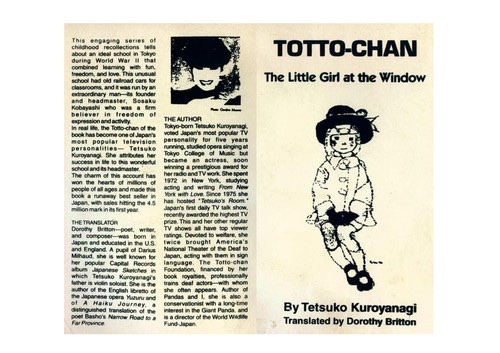
Cover of Totto-chan: The Little Girl at the Window

Totto-chan: The Little Girl at the Window

Tetsuko Kuroyanagi

4 ideas

  1. Expelled first-grader heard for four hours

    In 1940s Tokyo, six-year-old Tetsuko was expelled from her first school because she kept opening and slamming her desk lid, stood at the window calling in street musicians, and talked to swallows during class. At her interview at Tomoe Gakuen, headmaster Sosaku Kobayashi asked her to tell him anything she liked. He then listened attentively for about four hours until she ran out of things to say, and enrolled her. The school's other teachers had treated the same behavior as a disciplinary problem. Kobayashi treated it as an unspent need to be heard.

  2. Students choose the order of the day's lessons

    Each morning the teacher wrote all of the day's lessons and problems on the board. Every child then began with whichever subject they liked and worked through the list in their own sequence. Because every child's choices were visible, teachers could see each child's interests and ways of thinking as they emerged, rather than hiding them under one shared timetable. Children who finished in the morning were often rewarded with an afternoon walk, which tied their autonomy to real outcomes.

  3. Repeated affirmation reshapes a labeled child's identity

    Kobayashi regularly told Totto-chan, 'You're really a good girl, you know,' especially after she had caused trouble. The phrase was not a verdict on any single act. It was a standing statement of her worth that did not depend on her behavior. Kuroyanagi credits this repeated message with overriding the 'bad child' label her first school had given her, and with deciding the course of her life.

  4. Designing activities so difference goes unmarked

    Tomoe Gakuen deliberately arranged shared activities so that children with physical differences were not singled out. Children swam naked together, so that bodies like Yasuaki-chan's, disabled by polio, were simply ordinary. Sports-day events were designed around the short stature of Takahashi-kun, so that he won them. The approach did not tell children to accept difference. It changed the environment so that difference stopped being a basis for comparison.

Save and mark ideas in the app