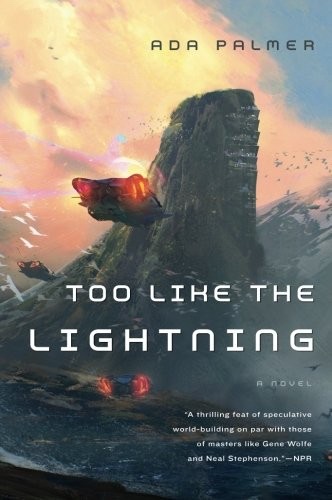
Cover of Too Like the Lightning

Too Like the Lightning

Ada Palmer

4 ideas

  1. The Stolen Seven-Ten List and O.S.

    In 2454 someone steals an advance copy of the annual Seven-Ten list, a newspaper ranking of the world's most influential people, and plants it in the Saneer-Weeksbooth household, the family that runs the global flying-car network. The investigation threatens to expose that this household has, for centuries, secretly carried out targeted assassinations, called O.S., on orders from Hive leaders to head off wars. The episode shows a celebrated peace resting on concealed, systematic murder that its beneficiaries both need and cannot admit to.

  2. Hives: Nations Decoupled From Territory

    Once near-instant flying-car transit made where you live irrelevant to where you work, the world replaced geographic nations with Hives. These are voluntary, non-territorial polities that adults choose based on shared values, such as the Humanists, Mitsubishi, Masons, Cousins and Utopians. Neighbors on the same street can belong to different governments and live under different laws. Citizenship becomes a subscription to a value system rather than an accident of birth, and each Hive competes for members.

  3. Suppressed Institutions Persist Through Sanctioned Workarounds

    After the Church War, the world banned public religion and group religious discussion, and it discouraged gendered language in favor of a universal 'they'. Neither religion nor gender disappears. Religious longing is routed to licensed one-on-one counselors called sensayers, while gender persists in private behavior, desire and power dynamics. Banning the public expression of a deep human need does not remove the need. It creates a regulated, semi-secret channel for it that accumulates its own hidden pressures.

  4. The Narrator's Pronoun Choices as Evidence

    The narrator, the convicted murderer Mycroft Canner, writes in an 18th-century style. He deliberately assigns 'he' or 'she' to characters according to his own judgment of their social role, which often contradicts their bodies. The reader is forced to notice how gendered language silently carries assumptions about power, aggression and care. His confessions of bias and concealment make the narration itself something the reader must interrogate rather than trust.

Save and mark ideas in the app