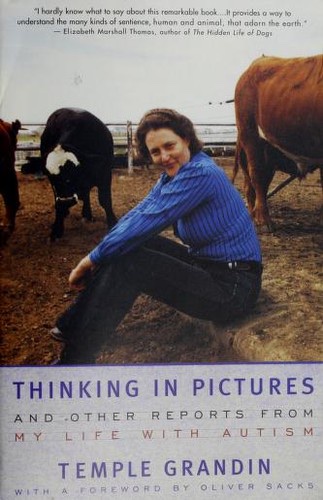
Cover of Thinking in Pictures

Thinking in Pictures

Temple Grandin

4 ideas

  1. Thinking in pictures as primary cognition

    Grandin reports that her thoughts arrive as detailed, specific images, like videos she can replay, rather than as words, and that language is a second tongue she translates into. Abstract concepts are held as sets of concrete examples: her idea of 'dog' is a catalog of particular dogs she has seen, not a verbal category. This lets her run full mental simulations of equipment, test-operating a design in her head before it is built.

  2. The squeeze machine from a cattle chute

    As a teenager on her aunt's Arizona ranch, Grandin saw that cattle calmed when held in a squeeze chute, climbed into one herself, and felt her own anxiety ease. She then built a human 'squeeze machine' that applies firm, even lateral pressure she can control, and used it to regulate her nervous system despite being disliked by school staff who saw it as strange. Her later study of deep pressure calming in animals and people grew from this self-experiment.

  3. See the facility through the animal's eyes

    Grandin identifies stress points in livestock handling by physically walking the chute at cattle eye level and noticing what the animal notices: shadows, glare, dangling chains, reflections, moving people ahead, and sudden contrasts that make animals balk. She argues her autistic sensory hyperacuity and fear-driven cognition resemble a prey animal's, which gives her access to details that verbal, abstraction-minded engineers filter out. Removing those small visual distractors, along with curved single-file races and solid sides, moves cattle calmly without force.

  4. Different minds, different but not less

    Grandin argues that autism is a different cognitive style with real strengths, such as visual detail, pattern memory, and focus, alongside real deficits, not only a set of deficits. She says the traits that make social life hard are the same ones that made her good at design work, and that fixations should be channeled into careers rather than extinguished. On this view the right intervention develops a person's native thinking style toward useful work, instead of forcing conformity to typical cognition.

Save and mark ideas in the app