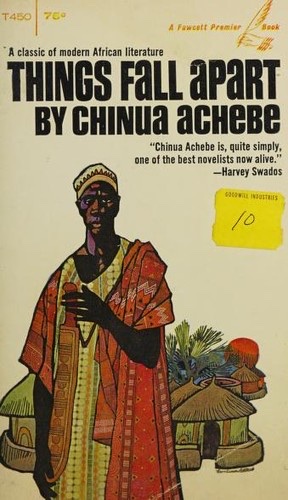
Cover of Things Fall Apart

Things Fall Apart

Chinua Achebe

4 ideas

  1. Okonkwo's rise, exile, and suicide

    Okonkwo, a wrestling champion and titled man of Umuofia, takes part in killing Ikemefuna, a hostage boy who calls him father, because he fears looking weak. Later he accidentally kills a clansman's son and is exiled for seven years. He returns to find the missionaries and colonial government entrenched, beheads a court messenger, and hangs himself when the clan will not rise with him, while the District Commissioner plans to give his story a paragraph in a book titled 'The Pacification of the Primitive Tribes of the Lower Niger.'

  2. Identity built against a feared father

    Okonkwo's whole character is organized as the negation of his father Unoka, an idle, indebted, gentle man, so any tenderness or hesitation in himself registers as a slide back toward failure. An identity defined by what it refuses to be cannot bend, so it overcorrects into cruelty and breaks when circumstances demand adaptation.

  3. Outsiders conquer through the system's outcasts

    The missionaries gain their first foothold among people the clan's own rules had marginalized: the osu (outcasts), mothers of abandoned twins, men without titles, and sons like Nwoye who doubted the old ways. A society's exclusions become the entry point for its disruption, because the newcomer offers belonging to those it cast out and splits the community from inside. As Obierika says, the white man 'has put a knife on the things that held us together and we have fallen apart.'

  4. Who holds the narrative defines history

    The book renders Igbo life from the inside, with its law, courts, proverbs, debates, and doubts, then closes by shrinking all of it to one paragraph in a colonizer's book. Reading any historical record, ask whose frame is doing the telling, because the same life can be a complex civilization or a footnote about 'pacifying primitives' depending on who writes it.

Save and mark ideas in the app