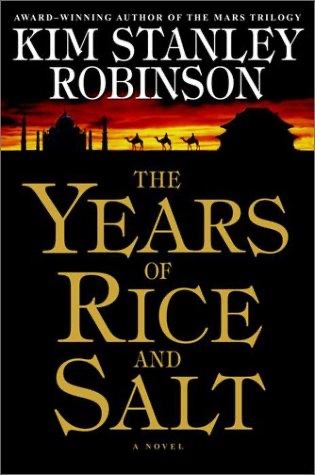
Cover of The Years of Rice and Salt

The Years of Rice and Salt

Kim Stanley Robinson

4 ideas

  1. Bold and Psin find emptied Europe

    In the opening part, Bold, a scout in Timur's army, rides with a small party into Hungary and finds towns full of unburied dead and no living people, because the plague has killed nearly everyone in Europe. Timur turns his army back east. The empty continent is later resettled by Muslim pioneers, and that single demographic erasure changes the course of every century that follows.

  2. Scientific revolution does not require Europe

    The novel argues that empirical science, mechanical invention and industrialisation grow out of general human conditions such as trade networks, military competition, and curious people with patronage. It shows the science happening instead in Samarkand, Islamic alchemy, and Chinese and Indian workshops. Removing Europe delays or reroutes discoveries like the laws of motion, gravitation and steam power, but does not prevent them. Progress appears as a convergent tendency with contingent carriers, not a cultural inheritance of one civilisation.

  3. The jati: a soul group reincarnated together

    A small group of souls is reborn together across centuries. The reader can track each soul because its names in every life begin with the same letter (B for the idealist, K for the rebel, I for the thinker). Between lives the group meets in the bardo, a Tibetan Buddhist afterlife realm, where they judge how they did and resolve to do better. This makes moral progress something learned over many lifetimes by the same agents, rather than won or lost in a single life.

  4. History as dialectic of struggle and compassion

    The book treats history as a long cycle of pain and gradual improvement. In each era, oppression (slavery, the confinement of women, war) meets resistance from people who push the world slightly toward justice and then die before they see results. The 67-year Long War and the feminist and scientific reforms that come after it show gains paid for by enormous suffering. Progress is real but fragile, cumulative and never guaranteed.

Save and mark ideas in the app