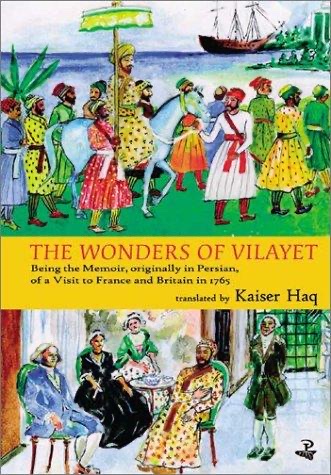
Cover of The Wonders of Vilayet

The Wonders of Vilayet

Mirza Sheikh I'tesamuddin

4 ideas

  1. The Mughal letter that never reached the King

    By his account, Robert Clive held back the letter and presents and used them for his own ends, so the emperor's petition never reached the King as intended and the mission returned with nothing. It is a concrete case of a colonial intermediary capturing the diplomatic channel between two sovereigns and deciding what each could say to the other.

  2. Reverse ethnography from a confident civilisation

    I'tesamuddin describes Britain as a curious foreign land measured against Mughal standards of courtliness, hierarchy, faith and learning, not as a superior model to be copied. Because he writes from assumed cultural equality or superiority, he records as oddities what British writers treated as normal, such as diet, dress, manners and religious practice. The observer's baseline determines what counts as strange, and reversing the usual direction of the traveller's gaze exposes the host society's unexamined habits.

  3. Unveiled women expose the observer's own norms

    He gives close attention to English women: they appear unveiled in public, mix freely with men, and are praised for beauty and accomplishment. He also records English acquaintances questioning the seclusion of Muslim women. Meeting a society that organises gender differently forces a traveller to justify customs he had taken as natural, so the question of women becomes the point where each culture's defaults are most openly contested.

  4. Organised knowledge and technique as imperial power

    Aboard ship and at Oxford, I'tesamuddin notes how the British systematise knowledge through navigation instruments, charts, disciplined shipboard routine, libraries and colleges. He links their growing strength less to individual brilliance than to institutions that accumulate, teach and apply learning, including the collection of Oriental manuscripts. The implication is that the balance of power between civilisations shifts through the institutional organisation of knowledge, not only through armies.

Save and mark ideas in the app