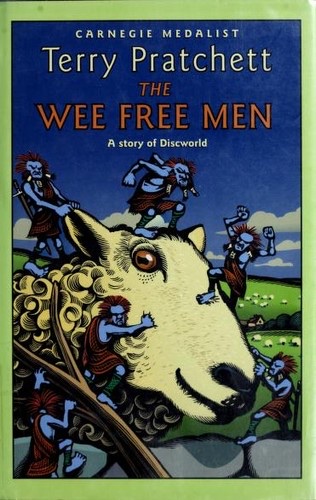
Cover of The Wee Free Men

The Wee Free Men

Terry Pratchett

4 ideas

  1. Tiffany rescues brother from Fairy Queen

    Nine-year-old Tiffany Aching, armed only with a frying pan and her own stubbornness, enters Fairyland with the Nac Mac Feegle to retrieve her sticky, sweet-obsessed little brother Wentworth, whom she does not particularly like. She defeats the Queen not with magic but by waking fully into her own senses and remembering the land she belongs to. The rescue is driven by duty and ownership ('he's mine') rather than affection, showing that responsibility can act where sentiment is absent.

  2. First Sight and Second Thoughts

    First Sight is the ability to see what is actually there rather than what you expect or wish to see. Second Thoughts is the habit of watching your own thinking as it happens. Together they make a person hard to deceive, because both the outside illusion and the inside assumption are being checked at once.

  3. Witchcraft is speaking for the voiceless

    Granny Aching was never called a witch and did no magic, yet she did the witch's real work: she stood between the powerful and those who could not defend themselves. Her rule was 'Them as can do has to do for them as can't, and someone has to speak up for them as has no voices.' On this view, authority comes from accepting responsibility for the vulnerable, and spells have little to do with it.

  4. Dreams as parasitic, self-sealing realities

    The Queen's world preys by trapping people inside dreams that feel complete. In them doubt is suppressed and the dreamer is kept from noticing contradictions or missing details. The escape is to notice what is wrong or absent and to insist on real sensory memory: the smell of sheep, the chalk underfoot, the weight of real ties. Comforting illusions are dangerous precisely because they remove the friction that signals something is off.

Save and mark ideas in the app