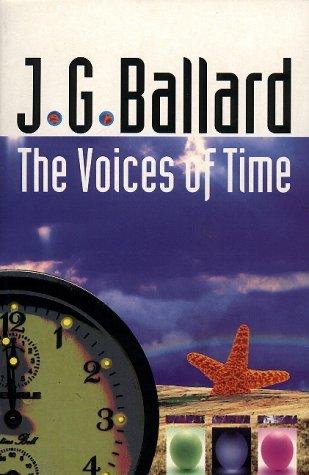
Cover of The Voices of Time

The Voices of Time

J. G. Ballard

4 ideas

  1. The neurosurgeon who built his own mandala

    Dr. Robert Powers, a neurosurgeon, is afflicted by a spreading narcoleptic syndrome that makes him sleep longer each day. He inherits the abandoned laboratory of his dead colleague Whitby, a biologist who carved a mysterious groove pattern into the floor of an empty swimming pool before his suicide. Instead of fighting his decline, Powers builds a huge concrete mandala at a deserted desert range and dies lying at its center, feeling himself absorbed into the vast rhythm of cosmic time.

  2. Silent genes as preloaded terminal adaptations

    The idea is that organisms carry latent programs for environments that do not yet exist. Whether these programs belong to the species' next stage or its final one is left open, which means evolution can look like preparation for ending rather than progress.

  3. Terminal documents and the cosmic countdown

    Kaldren, Powers' former patient, has been surgically made unable to sleep, and he collects 'terminal documents,' artifacts that record endings. Among them is a sequence of radio signals from distant stars that count down numerically toward the end of the universe. The countdown turns entropy from an abstract law into a legible message, a clock the characters can read. Knowing the end is scheduled changes their question from how to survive to how to meet it.

  4. Acceptance of dissolution as the true horror

    The story's dread comes from characters who calmly adapt to catastrophe, not from the catastrophe itself. External collapse (entropy, sleep, cosmic countdown) is mirrored in 'inner space,' so the end of the world plays out as a psychological reorientation toward surrender. Read this way, the sign of an ending is the moment people stop resisting and begin to find meaning in their own disappearance.

Save and mark ideas in the app