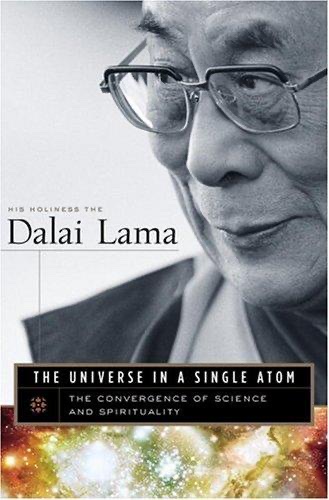
Cover of The Universe in a Single Atom

The Universe in a Single Atom

The Dalai Lama

6 ideas

  1. Buddhism must revise doctrine that science disproves

    If scientific analysis conclusively shows a Buddhist claim to be false, Buddhists must accept the finding and abandon the claim. The Dalai Lama applies this to traditional Abhidharma cosmology, including Mount Meru at the center of a flat world, and treats it as outdated. Empirical evidence is given authority over scriptural authority wherever the two genuinely conflict.

  2. Dependent origination as relational reality

    Nothing exists independently or by intrinsic nature. Every phenomenon arises through causes and conditions, through the relation of parts to whole, and through conceptual designation. The book sets this Buddhist view of emptiness beside quantum physics, where the properties of particles appear to depend on measurement and context rather than existing fixed in themselves.

  3. Three sources of valid knowledge

    Buddhist epistemology sorts claims into three kinds. Some are evident and known by direct perception. Some are slightly hidden and known by inference. Some are extremely hidden and accessible only through reliable testimony. Direct experience and reasoning always come before scripture, and testimony is accepted only for matters neither perception nor inference can reach.

  4. First-person introspection as scientific data

    Consciousness cannot be fully studied from the third-person view alone, because its defining feature is subjective experience. Trained contemplatives can serve as refined observers who report on their inner states with precision. Their reports can be paired with brain measurements, so science should add disciplined first-person methods rather than dismiss them.

  5. Consciousness cannot be reduced to brain matter

    Buddhism holds that each moment of consciousness must arise from a prior moment of consciousness as its substantial cause, not from matter alone. The Dalai Lama therefore argues that the physicalist assumption that mind is merely neural activity is a metaphysical premise, not an established finding. Neuroscience shows correlations between brain and experience, but correlation does not demonstrate that experience is produced by the brain.

  6. Science needs ethics grounded in compassion

    Scientific power, especially in genetics and biotechnology, is advancing faster than the moral wisdom needed to use it. The Dalai Lama argues that ethical guidance should rest on a secular foundation of compassion and on awareness of consequences across the whole interconnected system. It should not rest on religious dogma or on market forces alone. Scientists bear responsibility for applications, not just for discoveries.

Save and mark ideas in the app