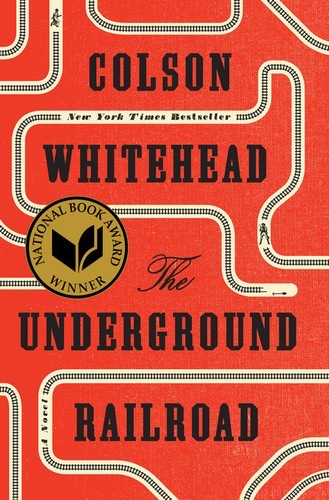
Cover of The Underground Railroad

The Underground Railroad

Colson Whitehead

4 ideas

  1. States as alternate Americas of control

    The novel turns geography into a catalogue of possible racial orders: each state Cora reaches runs a different system for managing Black people. Georgia uses open plantation terror, South Carolina uses paternalistic uplift that hides medical experimentation, North Carolina uses extermination and a ban on Black presence, and Indiana offers a free Black farm community that white neighbors destroy. Reading the journey state by state treats America's racial history as a set of competing designs, each carried to its logical end, rather than as one fixed past.

  2. Cora's escape from the Randall plantation

    Cora is an enslaved teenager on the Randall plantation in Georgia whose mother, Mabel, escaped and was never caught. Cora flees with a fellow slave named Caesar and kills a white boy who attacks them during the escape. At each stop she finds a new version of captivity presented as refuge.

  3. Benevolent institutions can conceal systematic abuse

    In the novel's South Carolina, Black residents get dormitories, schooling, and jobs, but the state's doctors are running a covert syphilis study on the men and pushing sterilization on the women. The mechanism is that apparent uplift makes the controlled population trust and depend on the institution, which then gives it cover for experimentation. The novel shifts this real 20th-century abuse, modeled on the Tuskegee study, into the 1850s to show that such abuse continues the logic of slavery rather than breaking from it.

  4. Literalized metaphor as historical argument

    By making the Underground Railroad an actual train with tracks and stations dug beneath the earth, the novel asks who built this infrastructure and at what cost. The answer is enslaved Black laborers, which echoes the fact that Black labor built America's visible infrastructure too. Turning a figure of speech into a physical object forces the reader to see the material labor and danger that the comforting historical metaphor had hidden.

Save and mark ideas in the app