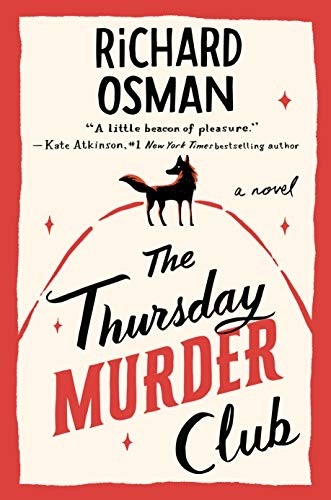
Cover of The Thursday Murder Club

The Thursday Murder Club

Richard Osman

4 ideas

  1. Coopers Chase Pensioners Investigate Live Murders

    At Coopers Chase, a luxury retirement village in Kent, Elizabeth (a former intelligence operative), Joyce (a retired nurse whose diary narrates parts of the book), Ibrahim (a psychiatrist) and Ron (a former trade-union firebrand) meet every Thursday in the Jigsaw Room to reopen unsolved murders from files kept by Penny Gray, a retired police inspector now in a coma. When builder Tony Curran is bludgeoned to death, and then developer Ian Ventham is poisoned during a protest over his plan to dig up the nuns' cemetery on the village grounds, the club runs its own parallel investigation. Elizabeth engineers PC Donna De Freitas's transfer onto the case so the pensioners have a police insider feeding them information, and DCI Chris Hudson grudgingly cooperates.

  2. Old Age as Investigative Camouflage

    Society stops seeing the elderly as agents, so pensioners are not treated as threats, their questions are read as harmless curiosity, and their lies are rarely checked. The club deliberately plays up frailty, confusion and chattiness to extract information that police interviews cannot. Being underestimated works as a tool: low expectations lower others' guard.

  3. Former Careers as a Composite Toolkit

    The club solves problems by pooling the professional skills each member kept from working life. Elizabeth brings operational tradecraft and contacts, Ibrahim brings psychological profiling and methodical analysis, Ron brings confrontational advocacy and working-class networks, and Joyce brings a nurse's practical knowledge of bodies and drugs plus disarming friendliness. Retirement does not erase expertise: a group of retirees is a latent, cross-disciplinary team that only needs a shared problem to reactivate.

  4. Nearness to Death Shifts Moral Calculations

    Characters near the end of life weigh law, loyalty and secrecy differently because they have little left to lose and long-buried debts to settle. Past wrongs, private acts of mercy, and old loves come to the surface. The book suggests that deciding what justice requires becomes more personal and less procedural when time is running out.

Save and mark ideas in the app