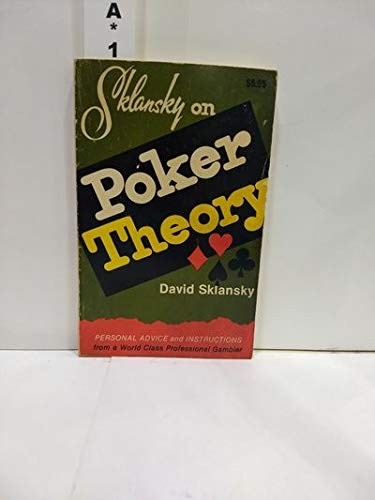
Cover of The Theory of Poker

The Theory of Poker

David Sklansky

5 ideas

  1. The Fundamental Theorem of Poker

    Every time you play a hand differently from how you would if you could see all your opponents' cards, they gain; every time they play differently from how they would if they could see yours, you gain. Profit is therefore the accumulated gap between each player's actual decisions and their perfect-information decisions, and all strategy reduces to narrowing your own gap while widening theirs.

  2. Pot odds versus drawing odds

    A call is correct when the ratio of money in the pot to the cost of calling exceeds the odds against completing your hand. Implied odds extend this by counting the money you expect to win on later rounds if you hit, and reverse implied odds subtract what you will lose when you make a second-best hand.

  3. Judge decisions by expectation, not results

    A play is right or wrong based on its expected value at the moment it is made, regardless of whether the cards that follow win or lose. Short-term outcomes are dominated by variance, so evaluating yourself by results teaches you the wrong lessons, while repeating positive-expectation decisions guarantees profit in the long run.

  4. Semi-bluffing: two ways to win

    A semi-bluff is a bet with a hand that is probably not best now but could improve to the best hand. It wins immediately when opponents fold and wins in a showdown when the draw completes, so the combined equity can make betting profitable even when pure bluffing or pure calling would not be.

  5. Reading hands through reverse inference

    Put an opponent on a range of possible hands and narrow it with every action, asking which hands would plausibly play the way they did given their tendencies and the board. Combine this with a count of how many hands in the range beat you to decide whether to bet, call, or fold, instead of assigning them one specific hand.

Save and mark ideas in the app