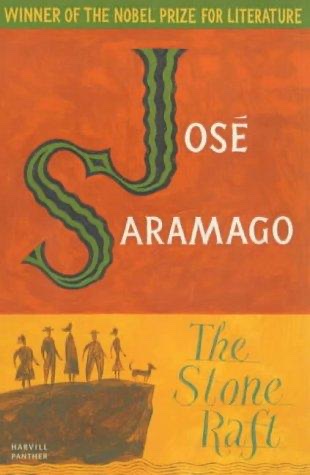
Cover of The Stone Raft

The Stone Raft

José Saramago

4 ideas

  1. Iberia snaps free along the Pyrenees

    A crack opens along the Pyrenees and the whole Iberian Peninsula detaches from France and drifts west into the Atlantic, heading toward the Azores before its course shifts. At the same moment five strangers are marked by small uncanny events: Joana Carda scratches a line in the ground with an elm stick, Joaquim Sassa throws a heavy stone impossibly far out to sea, José Anaiço is trailed by a flock of starlings, the pharmacist Pedro Orce feels the earth trembling beneath him, and Maria Guavaira unravels a blue sock into an endless thread. These five, with a mysterious dog, travel together across the moving landmass.

  2. Iberia's true orientation is southern Atlantic

    The novel stages Portugal and Spain's 1980s entry into the European Community as a question of belonging, and physically answers it by severing the peninsula from Europe. By drifting Iberia toward Africa and Latin America, it argues that the region's historical and cultural kinship lies with the Atlantic and global South it colonized and traded with, not with a northern Europe that regards it as a periphery. Europe's reaction confirms the point: official relief and indifference mixed with scattered popular declarations that 'we too are Iberians.'

  3. Bureaucracy meets the impossible with procedure

    When a continent-sized event occurs, governments do not reckon with its meaning. They issue communiqués, hold meetings, manage evacuations of tourists and property, and look for someone to hold accountable, turning the uncanny into paperwork. Read this way, institutional response reveals less about the event than about the institution's reflex to shrink any reality until it fits its forms.

  4. Small private acts mistaken as causes

    Each of the five characters suspects that their own trivial gesture, such as a line scratched in dirt or a thrown stone, caused the rupture, and the authorities pursue them for the same reason. The novel exploits the human habit of linking coincident events into cause and effect. It uses that habit both to bind strangers into a shared fate and to mock the official hunt for a responsible party behind an event that has no author.

Save and mark ideas in the app