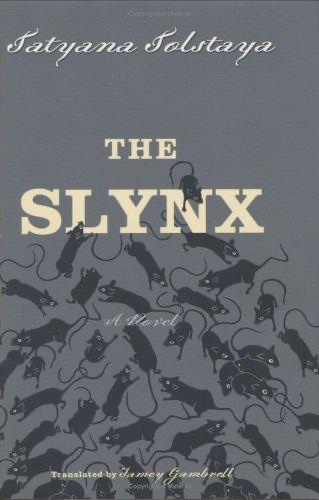
Cover of The Slynx

The Slynx

Tatyana Tolstaya

4 ideas

  1. Benedikt, the scribe who devoured forbidden books

    Benedikt copies Pushkin and other classics by hand in Fyodor-Kuzmichsk, the village that was once Moscow, believing the tyrant Fyodor Kuzmich wrote them. After he marries into the family of the Head Saniturion, whose men seize anyone caught with pre-Blast books, he finds his father-in-law's hoard of forbidden volumes and reads them compulsively, with no ability to judge or understand what he reads.

  2. Preserving texts without context preserves nothing

    A culture can keep its texts physically intact and still lose them, because meaning depends on shared references that did not survive. Copying, collecting and reading become rituals of consumption: the reader gets the words but not the ideas, so great literature leaves him no wiser or kinder. Access to a canon is not the same as inheriting it.

  3. The Slynx: invisible fear that governs behavior

    The Slynx is an unseen creature said to lurk in the forest and leap onto the backs of careless people, severing the vein that keeps them sane. Nobody has seen it, yet the whole village orders its conduct around it. It stands for a vague, internalized dread that does a regime's policing more effectively than any enforcer, and for a spiritual emptiness that ends up inside the person who fears it.

  4. Coups in a hollowed culture only swap tyrants

    When the Head Saniturion overthrows Fyodor Kuzmich in the name of freedom, he simply becomes the new despot, with new decrees and the same seizures. Nobody in the society has the concepts to imagine a different order, so revolution just repeats the old one. Control of memory and authorship, such as a ruler claiming the classics as his own, lets whoever holds power define reality.

Save and mark ideas in the app