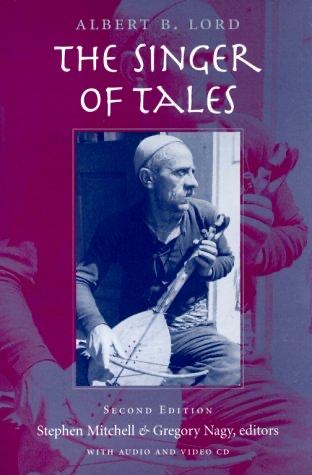
Cover of The Singer of Tales

The Singer of Tales

Milman Parry and Albert B. Lord

10 ideas

  1. The formula as metrical building block

    A formula is a group of words regularly used under the same metrical conditions to express a given essential idea, such as 'swift-footed Achilles' or a line-opening that fits one slot of the verse. Singers do not choose words one by one; they reach for ready-made phrases already shaped to the meter, which makes rapid composition under performance pressure possible. Formulas also exist as substitution systems, patterns in which one word can be swapped to generate new lines on the same template.

  2. Themes as recurring narrative scene templates

    Beyond the level of the phrase, singers work with themes: repeated groups of ideas such as the assembly, the arming of the hero, the journey, or the feast. Each theme has a stable core but can be expanded or compressed depending on the audience, the singer's energy, and the length of the evening. A song is built by chaining themes together, so the singer holds the plot as a sequence of familiar scene-types rather than as a fixed text.

  3. Oral epics are recomposed in each performance

    In an oral tradition there is no original or fixed text of a song; every performance is a new composition built from the same stock of formulas and themes. Singers sincerely claim to sing a song 'word for word, the same' each time, yet recordings show large variation in length, detail, and wording. For them, 'the same song' means the same story and essential ideas, not identical words.

  4. Avdo Međedović outsings the song he heard

    Parry and Lord had the illiterate Bosnian guslar Avdo Međedović listen to another singer perform a song he had never heard before. Avdo then sang the same story back, expanding it to nearly three times its length and enriching it with his own descriptions and scenes. He also dictated and sang epics of more than 12,000 lines, which showed that a Homeric-scale poem can be produced without writing.

  5. Three-stage apprenticeship of the oral singer

    A singer is formed in stages. First, he listens as a boy and absorbs the rhythm, formulas, and stories. Next, he begins singing and learns to fit his own lines into the meter using the formulas he has heard. Finally, he performs before critical audiences, building a repertoire and the ability to expand, shorten, and adapt songs at will. Mastery means fluency in a generative grammar of song, not a store of memorised texts.

  6. Literacy destroys the oral-formulaic capacity

    Once singers learn to read and come to believe in a fixed, correct text, they begin memorising printed versions, and the ability to compose in performance declines. Oral composition and literate composition are different techniques, not points on one continuum, so a single poet is unlikely to be skilled in both at once. On this view the Homeric poems as we have them were most plausibly dictated by an oral poet to a scribe, not composed in writing.

  7. Oral epic is composed during performance

    The guslar does not memorize a text and recite it; each performance is a fresh composition built live from formulas and themes. There is no original or authoritative version of a song, only a multiplicity of performances. A singer who insists he sang it 'exactly the same, word for word' means the same story, not the same wording.

  8. Avdo Međedović's twelve-thousand-line epic

    Parry and Lord recorded the illiterate Bosnian singer Avdo Međedović performing 'The Wedding of Smailagić Meho' at over 12,000 lines, roughly the length of the Odyssey. On hearing a song new to him, Avdo could immediately sing it back longer and richer than the original singer by expanding its themes. His feat showed that oral composition, with no writing, can produce epics of Homeric scale and quality.

  9. Literacy destroys the oral singer's craft

    Once a singer learns to read and comes to believe in a fixed, correct text, he begins memorizing rather than composing and loses the generative method. Oral and written composition are distinct techniques, not points on a smooth continuum. Printed song collections thus kill living traditions by freezing one performance as authoritative.

  10. Formula density reveals a text's oral origin

    Analyzing a text's repeated phrases shows how much of it is built from formulaic language, and a very high proportion signals composition in performance rather than at a writing desk. Applying this test to Homer and to medieval epics like Beowulf and the Chanson de Roland reframes them as dictated records of oral performances. Their repetitions and inconsistencies then read as marks of a composing method, not as flaws or later tampering.

Save and mark ideas in the app