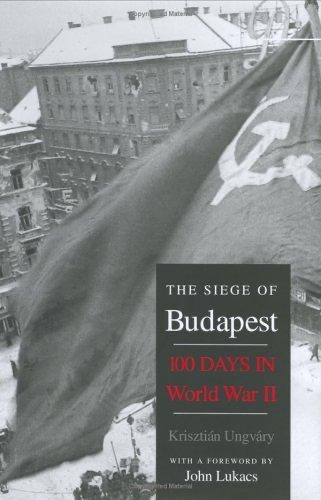
Cover of The Siege of Budapest

The Siege of Budapest

Krisztián Ungváry

4 ideas

  1. The Buda breakout of 11 February 1945

    After Hitler forbade surrender or evacuation of Budapest, the encircled German-Hungarian garrison under SS General Pfeffer-Wildenbruch finally attempted a breakout from Buda on the night of 11 February 1945, with roughly 28,000 soldiers and many civilians pushing through narrow streets and wooded hills into prepared Soviet positions. Only about 700 reached German lines; the rest were killed or captured within days. The episode shows how a breakout delayed until a force is exhausted, starved and fully encircled turns an evacuation into a massacre.

  2. Fortress orders sacrifice cities for political symbolism

    Hitler's designation of Budapest as a 'Festung' to be held street by street served political and prestige aims, such as tying down Soviet forces and demonstrating resolve, rather than any realistic military objective, since relief offensives were too weak to break through. Holding a doomed city prolonged the fighting by weeks and multiplied military and civilian deaths without changing the war's outcome. A no-retreat order from distant leadership shifts the costs of symbolic defiance onto the people trapped inside.

  3. War seen from the cellar

    From that vantage, the 'front line' runs through apartment blocks, and for roughly 800,000 trapped civilians the dangers came from their own side, the defenders and the victors alike. Oral testimony checked against archives exposes costs that operational histories structurally omit.

  4. Siege as a collapse of authority

    Under encirclement, legitimate authority disintegrates, and armed factions such as Arrow Cross militias, deserters and individual units fill the vacuum with arbitrary violence against civilians and scapegoated groups. The conquering army's arrival brings no restored order: mass plunder, rape and forced-labour roundups follow. For civilians, the most lethal phase is often the power vacuum, before and after the formal fighting, rather than the combat itself.

Save and mark ideas in the app