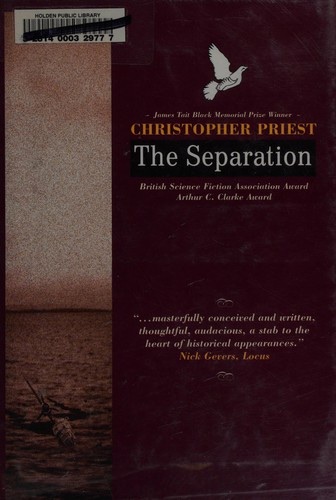
Cover of The Separation

The Separation

United Kingdom · 1936–1941

4 ideas

Buy on Amazon

In wartime Britain, identical twins take different paths: one flies bombers for the RAF, while the other serves as a pacifist ambulance driver. Their accounts of events around 1941 refuse to fit together. Christopher Priest turns that divide into an alternate-history novel about what people can know of a war.

  1. Twin Sawyers and the Hess Peace

    Identical twins Jack and Joe Sawyer, both signing as J.L. Sawyer, win an Olympic rowing bronze in Berlin in 1936 and meet Rudolf Hess there. By 1941 they are split: Jack flies Wellington bombers for the RAF, while Joe is a conscientious objector driving Red Cross ambulances through the Blitz. In Joe's account, Hess's May 1941 flight to Britain becomes a real peace mission that ends the Anglo-German war. In Jack's account, the war grinds on into history as we know it.

  2. Archive that verifies two incompatible pasts

    The frame narrator is a historian who finds that diaries, memoirs and official records each hold up internally yet contradict one another about the same events. Documentary evidence does not settle what happened. Each source quietly assumes a single timeline, so reconciling them means discarding testimony that is otherwise credible.

  3. Records track names, not persons

    Because both brothers are 'J.L. Sawyer,' every file, letter and mention in Churchill's memoirs can attach to either man. Bureaucracy indexes identifiers rather than individuals, so one documentary identity can silently merge two divergent lives. That merging makes the confusion invisible until someone tries to trace a single biography through it.

  4. Bombing seen from both ends

    The same strategic bombing campaign looks entirely different to the pilot releasing bombs from altitude and to the driver pulling bodies from rubble. Distance turns destruction into an operational task, while proximity turns it into injured individuals. The brothers' opposed moral positions come less from temperament than from where each stands relative to the violence.

Save ideas and give them a thumbs up or down in the app