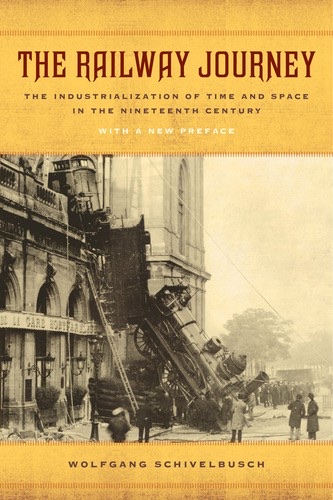
Cover of The Railway Journey

The Railway Journey

Wolfgang Schivelbusch

6 ideas

  1. Annihilation of Space and Time

    Railway speed shrank the effective distance between places, pulling remote regions into the market orbit of cities while also stripping them of the local uniqueness that remoteness had protected. Space was diminished and expanded at once: fewer places mattered as destinations, while the reachable territory grew.

  2. Panoramic Perception of Moving Landscape

    At train speed the foreground blurs and vanishes, so the traveller loses the near, tactile connection to the land that coach travel allowed and instead sees a distant, continuous stream of scenery. Travellers learned to experience landscape as a moving panorama to be consumed visually, a new perceptual habit that trained the eye for later forms such as the department-store display and cinema.

  3. Machine Ensemble Replaces Organic Travel

    Rails, wheels, locomotive and track worked as a single mechanical ensemble, cutting travel off from the animal power, weather and terrain that had shaped coach journeys. Once motion no longer depended on horses' fatigue or road conditions, the traveller related to the journey only as a transit between points rather than as an experience of the space crossed.

  4. Railway Spine and Traumatic Neurosis

    Victorian passengers in train crashes developed debilitating symptoms without visible injury, and physicians first attributed these to microscopic spinal damage, calling it 'railway spine'. The diagnosis gradually shifted toward shock and fright acting on the nerves, helping create the modern concept of psychological trauma and making it a matter for compensation law.

  5. Stimulus Shield Built by Habituation

    Early passengers suffered fatigue and anxiety from constant jolts, noise and a flood of fleeting impressions, but repeated exposure led them to develop a protective indifference to the stimuli. Treat modern composure as a learned numbing layer: underneath lies latent fear of catastrophe, which erupts violently when the technology fails.

  6. Compartment Isolation and Reading Travellers

    The European compartment carried over the coach's face-to-face seating but removed the conversation that long, slow journeys had encouraged, leaving strangers stuck facing each other in awkward silence. Reading became the standard escape from that discomfort and from the empty landscape, which fuelled station bookstalls, while isolation in closed compartments also fed fears of crime. By contrast, the open American coach mirrored a more egalitarian, mobile social order.

Save and mark ideas in the app