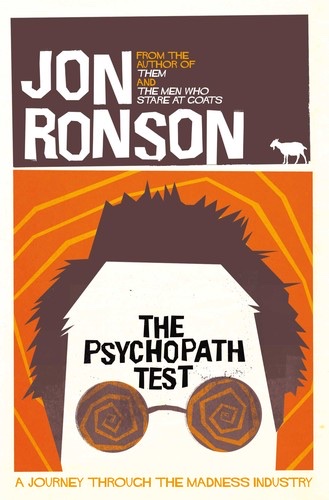
Cover of The Psychopath Test

The Psychopath Test

Jon Ronson

4 ideas

  1. Tony faked madness to escape prison

    Tony, jailed for grievous bodily harm at 17, was advised to feign insanity to avoid prison. He borrowed details from films such as Blue Velvet and ended up in Broadmoor secure hospital for 12 years, where psychiatrists took his calm efforts to prove he was sane as further evidence of psychopathy. The case shows how a diagnosis, once assigned, can turn any behaviour, including acting normal, into confirming evidence.

  2. Hare's PCL-R twenty-item psychopathy checklist

    Robert Hare's Psychopathy Checklist-Revised scores 20 traits, such as glibness and superficial charm, grandiosity, pathological lying, lack of remorse, shallow affect, and a parasitic lifestyle. Each is rated 0, 1 or 2 from an interview and file review, and a total of 30 or more out of 40 is the usual cut-off for a psychopathy diagnosis. Scores feed directly into parole, sentencing and detention decisions.

  3. Checklist training turns amateurs into overconfident diagnosers

    After a three-day PCL-R course, Ronson finds himself scoring everyone he meets, including a former Sunbeam CEO, Al Dunlap, who recasts his checklist traits as leadership virtues. Having a scoring tool creates a feeling of expert perception, so an untrained observer starts seeing pathology everywhere and matching ambiguous behaviour to the list. The danger is that the tool feels like insight while mostly amplifying the observer's existing suspicions.

  4. The madness industry rewards the most extreme cases

    Media producers, journalists and diagnosticians all select for people who are mad in exactly the right, entertaining way, and they filter out ordinary or ambiguous cases. At the same time, broadening DSM categories, with pharmaceutical incentives behind them, pathologizes normal variation, as with the surge in childhood bipolar diagnoses. Together these forces make madness look both more lurid and more common than it is, and labels get applied to fit the market's needs rather than the person.

Save and mark ideas in the app