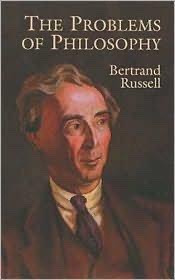
Cover of The Problems of Philosophy

The Problems of Philosophy

Bertrand Russell

6 ideas

  1. The table that changes with viewpoint

    A table's colour, shape and texture differ depending on the light, the angle, and whether you look with the naked eye or a microscope. No single appearance has a better claim than the others to be the 'real' colour or shape. So what we directly perceive (sense-data) must be distinguished from the physical object, whose existence and nature must be inferred.

  2. Knowledge by acquaintance versus by description

    We know some things directly through acquaintance: present sense-data, memories, universals, and perhaps ourselves. We know everything else, such as physical objects, other minds and historical figures, only by description, as 'whatever it is that' fits certain properties. Every proposition we can understand must be composed wholly of constituents we are acquainted with.

  3. The chicken fed daily until slaughter

    A chicken that has been fed every day comes to expect food from the man who feeds it. One day the same man wrings its neck. Past regularity creates strong expectation but gives no guarantee about the future: 'more refined views as to the uniformity of nature would have been useful to the chicken.'

  4. Induction cannot justify itself from experience

    Any argument that the future will resemble the past because it has so far already assumes the inductive principle it tries to prove. The principle can therefore be neither proved nor disproved by experience. It must be accepted on its intrinsic evidence, or we must give up all expectation about the future.

  5. Universals exist independently of minds

    Relations such as 'north of' are neither physical objects nor mental ideas. 'Edinburgh is north of London' was true before anyone thought it. Such universals subsist timelessly and are known directly, and this acquaintance is what makes a priori knowledge of logic and mathematics possible, since that knowledge concerns relations between universals and not particular facts.

  6. Philosophy's value lies in its uncertainty

    Once a question can be answered definitely it becomes a science, so philosophy is always left with the questions that stay open. Its value is not answers but enlarging our sense of what is possible, loosening the 'tyranny of custom', and freeing the mind from the narrow prison of private interest. Contemplating the universe impartially makes the self larger rather than shrinking the world to fit the self.

Save and mark ideas in the app