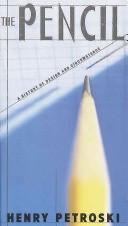
Cover of The Pencil

The Pencil

Henry Petroski

4 ideas

  1. Conté's graphite-clay lead under wartime blockade

    In the 1790s, war with England cut France off from the pure graphite of the Borrowdale mine in Cumberland, which had been the prized source of pencil lead. Nicolas-Jacques Conté responded by mixing powdered low-grade graphite with clay and firing it in a kiln. Changing the ratio of clay to graphite gave controllable degrees of hardness, and this process still underlies the graded leads made today. A supply shortage produced a design that was better than the natural material it replaced.

  2. Thoreau's pencil work in the family business

    Henry David Thoreau worked in his family's pencil business in Concord, Massachusetts. There he improved graphite grinding and lead formulation until the firm's pencils rivaled European imports. The most profitable result was not the pencil at all: the finely ground graphite sold for electrotyping in printing. The episode shows that a writer remembered for rejecting commerce was also a hands-on engineer, and that mastering one process can open an unexpected market.

  3. Form follows failure, not function

    Artifacts evolve because users notice specific shortcomings in the current version, such as leads that break, smudge or scratch, or wood that splits or is hard to sharpen. Designers then change the object to remove those faults. Each fix introduces new trade-offs, so no design is ever final, and the pencil's shape records a long chain of corrected failures rather than a single ideal derived from its purpose.

  4. The mundane object as hidden engineering

    Because a pencil is cheap and everywhere, people assume it is simple. In fact, making one depends on sourcing minerals, choosing timber, formulating the lead, and precise mass manufacturing. Examining such an overlooked object shows how much tacit know-how and trial and error sit inside everyday things, and why engineering stays culturally invisible when it works well.

Save and mark ideas in the app