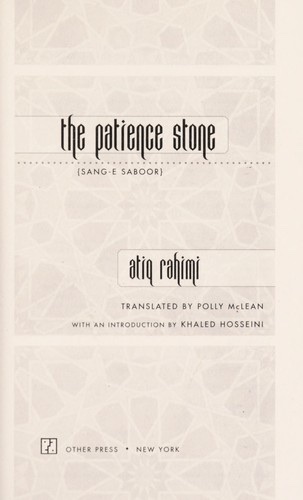
Cover of The Patience Stone

The Patience Stone

Atiq Rahimi

4 ideas

  1. Wife confesses to her comatose husband

    In an unnamed war-torn Afghan city, a woman nurses her husband, a jihadi fighter left comatose, eyes open, by a bullet in the neck after a petty quarrel. Alone with his unresponsive body, she tells him everything she was never allowed to say: her sexual frustration, the humiliations of their marriage, and finally that he was the infertile one and that their two daughters were fathered by another man. When the confession is complete the husband stirs and attacks her, and the novel ends in violence between them.

  2. The patience stone as confessor

    In Persian folk belief, the sang-e sabur is a stone to which a person tells every sorrow and secret. It absorbs them without reply until the day it shatters, and on that day the speaker is freed. The novel makes the comatose husband this stone, so that the confession becomes a way for her to be released and a way for him to be destroyed.

  3. Silenced people speak only to powerless listeners

    A person denied speech by a hierarchy can say the truth only when the dominant party can no longer punish, interrupt, or answer. The listener's incapacity is what makes honesty possible. When the listener's power returns, the truth that was safe to speak becomes lethal, which shows that the silence was enforced by threat rather than by a lack of anything to say.

  4. Honor codes make dishonor a shield

    A system that measures a woman's worth by her purity also gives her a perverse defense. When armed men enter her house, she declares herself a prostitute, and they back off because such a woman is beneath their interest. Seen this way, the rules that confine women also open loopholes, and survival can depend on claiming the degraded status the code assigns.

Save and mark ideas in the app