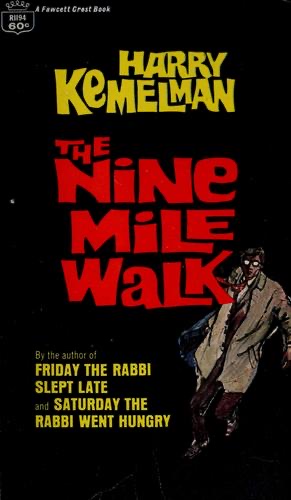
Cover of The Nine Mile Walk

The Nine Mile Walk

Harry Kemelman

5 ideas

  1. One overheard sentence reveals a murder

    A county attorney bets his friend Professor Nicky Welt that no ten-or-twelve-word sentence can support a meaningful chain of inferences, and offers one he overheard: 'A nine mile walk is no joke, especially in the rain.' Welt reasons from the sentence, a map and a railway timetable that the speakers were unwilling walkers heading at night toward a station on a fixed schedule, and so must have been hiding something.

  2. Logical inference is not proof of truth

    The story opens on Welt's point that a chain of inferences can be perfectly valid at every step and still arrive at a false conclusion, because each link only narrows the possibilities. The chain earns trust only when its end point is checked against the world. In the story, logic produces a hypothesis and verification turns it into knowledge.

  3. Casual phrasing leaks the speaker's circumstances

    Throwaway words like 'no joke' and 'especially' carry information the speaker never meant to give. 'No joke' marks the walk as a grievance, not a choice.

  4. Anchor speculation to fixed external schedules

    Pure inference drifts until it is tied to hard, independent facts such as distances between towns, when buses stop running and when a train makes its stop. Crossing the inferred situation against these rigid constraints eliminates most possibilities and leaves a narrow window of time and place. That window is concrete enough for someone else to go and check.

  5. Reasoning can reveal crimes nobody reported

    Ordinary detection starts from a known crime and works back to a culprit. Seen this way, small oddities in everyday life are possible traces of hidden events rather than noise.

Save and mark ideas in the app