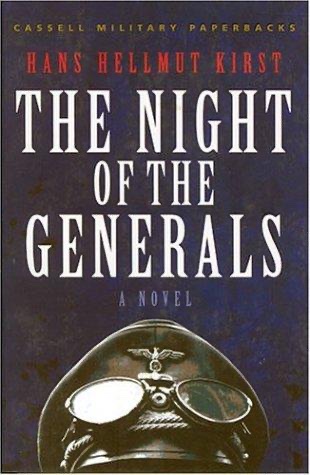
Cover of The Night of the Generals

The Night of the Generals

Hans Hellmut Kirst

4 ideas

  1. Major Grau hunts a murderous general

    In occupied Warsaw in 1942, a prostitute is butchered, and a witness glimpses a Wehrmacht general's uniform trousers with their red stripe. Abwehr Major Grau narrows the suspects to three generals, and his persistence gets him transferred away. When a similar killing occurs in Paris during the chaos of the July 1944 plot against Hitler, Grau resumes the hunt, and the case is closed only after the war, when the general is exposed and dies by suicide.

  2. Mass killing honored, single killing prosecuted

    The same institution can decorate a man for sending thousands to their deaths and hunt him as a criminal for strangling one woman. The difference is not the act but whether it was authorized: sanctioned violence counts as duty, and unsanctioned violence counts as murder. Viewed this way, the lone investigator's scruple looks both heroic and absurd, because he enforces a moral line that the surrounding system has already erased.

  3. Rank shields crime inside hierarchies

    Where authority is organized by rank, a high-ranking offender is protected less by concealment than by the system itself. Subordinates cannot question him, and peers close ranks to protect the institution's image. Anyone who investigates upward is recast as the problem and gets transferred, obstructed, or eliminated.

  4. Political upheaval as cover for private crime

    A moment of institutional crisis, such as a coup attempt, a purge, or a collapse, gives an individual criminal cover. Normal oversight is suspended, violence becomes routine, and a private act can be disguised as part of the larger turmoil or blamed on its designated enemies. The killer exploits the chaos of July 1944 in Paris because nobody is looking at a single death while the state is fighting over itself.

Save and mark ideas in the app