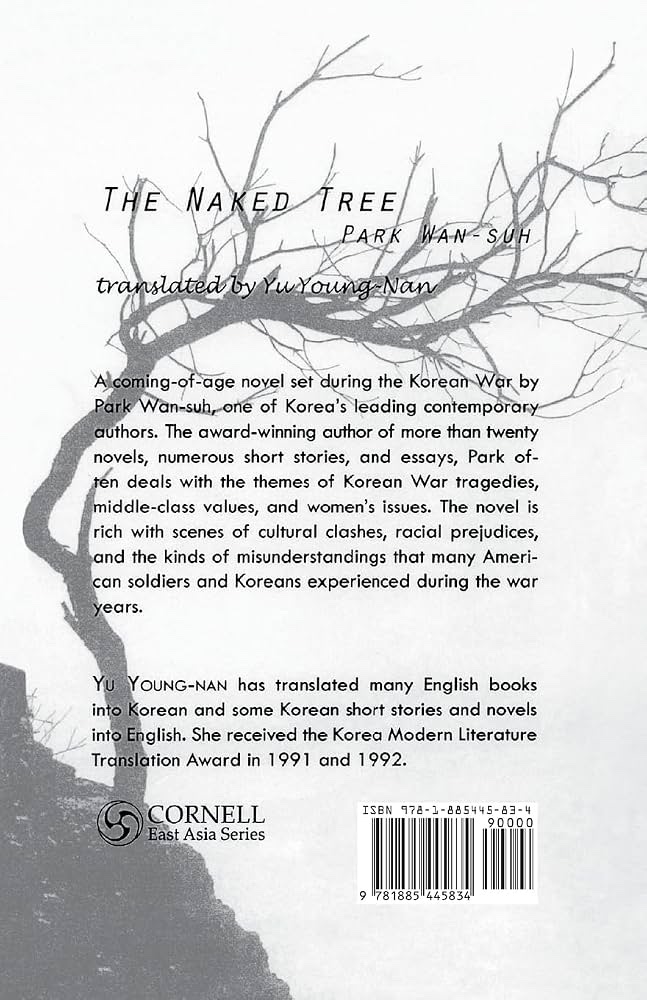
Cover of The Naked Tree

The Naked Tree

South Korea · 1950s

3 ideas

Buy on Amazon

In Seoul during the Korean War, a young woman works at a US Army PX and returns home to a mother grieving her sons. She finds herself drawn to a struggling painter. The novel holds their possible connection alongside the daily work and private grief of civilian life in wartime.

  1. Dead tree or winter tree waiting

    Years later Kyung-a sees Ok's painting of a leafless tree. She had remembered it as a withered, dead tree, but now reads it as a bare tree in winter, holding life until spring. The same devastated image can be read as ending or as dormancy, and which one you see depends on whether the viewer has come through her own winter.

  2. Grief for the dead erases the living

    A parent absorbed in mourning lost children withdraws attention from the child who survived, so the survivor is bereaved twice: of the siblings, and of the parent who is still alive. The survivor then carries both unwanted guilt for having lived and resentment at being unseen. Mourning becomes a household regime that the living must serve rather than share.

  3. Art reduced to occupation-economy piecework

    Under wartime foreign military presence, serious painters survive by mass-producing portraits of soldiers' girlfriends for dollars in a PX shop. Artistic skill is converted into a commodity for the occupier's sentimental demand. The artist's inner work continues only in secret and is recognized only after the conditions that degraded it have passed.

Save ideas and give them a thumbs up or down in the app