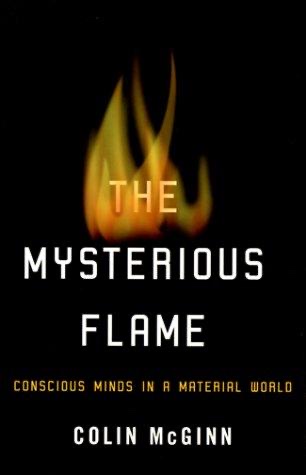
Cover of The Mysterious Flame

The Mysterious Flame

Colin McGinn

6 ideas

  1. Cognitive closure of a mind to properties

    A mind is cognitively closed to a property when the concept-forming procedures it has cannot grasp that property. The limit is not a lack of time or data. It is structural, the same way a dog is closed to calculus however long it is trained. Closure is relative to a kind of mind, so a property can be perfectly real and natural and still be unreachable for one species while another species could understand it.

  2. Consciousness has a natural but unknowable basis

    Some natural property of the brain explains how consciousness arises from neural tissue, so there is nothing supernatural at work. Human minds are cognitively closed to that property, though. The mind-body problem is therefore a real problem with a real, non-miraculous answer that we are permanently unable to reach.

  3. Introspection and perception both fail

    We have two routes to the mind-brain link. Introspection shows us conscious states but not their neural basis. Perception and science show us the brain but never consciousness itself. Because neither faculty can bring both sides into view at once, no amount of combining them will produce the concept that links the two.

  4. Spatial concepts cannot capture nonspatial consciousness

    Our concepts are built around objects that have location, extension and parts in space, and all of science works in those terms. Conscious experience does not seem to have size, shape or location in the way neurons do.

  5. Mysterianism avoids both materialism and dualism

    Materialist reductions leave out what experience is like. Dualism brings in an unexplained nonphysical substance. Once you accept that the link is real but hidden from us, you do not have to deny consciousness or leave naturalism, and the endless deadlock between the two positions starts to look like evidence of our own limits.

  6. Human intelligence as a biological adaptation

    Human intelligence evolved to solve particular survival problems, not to be a universal problem-solver. Its strengths come with built-in blind spots. The persistence of certain philosophical puzzles, such as consciousness, free will and the self, may reflect the shape of our minds rather than how hard the world is.

Save and mark ideas in the app