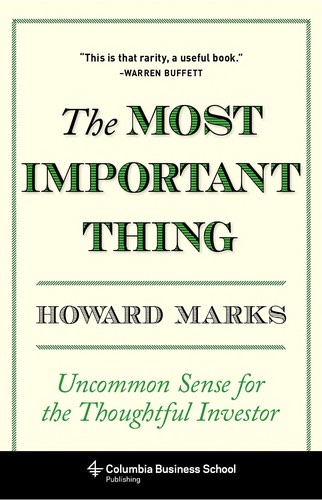
Cover of The Most Important Thing

The Most Important Thing

Howard Marks

5 ideas

  1. Second-Level Thinking Beats the Consensus

    First-level thinking reaches the obvious conclusion: 'good company, buy the stock.' Second-level thinking asks what the consensus already expects, how far that is priced in, what could go differently, and what happens then. Superior returns come only from views that are both different from the consensus and more accurate, because anything everyone believes is already in the price.

  2. Risk Means Permanent Loss, Not Volatility

    The risk that matters is the probability of permanently losing capital, not the price fluctuation that academic models measure. This risk cannot be seen or measured beforehand, and often not even afterward, because an investment that turned out fine may still have been risky. Risk rises as prices rise, since the most dangerous condition is the belief that nothing can go wrong.

  3. Outcomes Are Draws From Alternative Histories

    Any result is one draw from a range of outcomes that could have happened. A decision can be judged only by the full distribution of possibilities it faced, not by the one that occurred. A bold bet that paid off may have been a bad decision that got lucky, so short-run records cannot tell skill from randomness.

  4. The Pendulum of Investor Psychology

    Market sentiment rarely rests at the reasonable midpoint. It swings between greed and fear, credulity and skepticism, and risk tolerance and risk aversion, and each extreme sets up the reversal that follows. Cycles are driven by crowd psychology overcorrecting, not by fundamentals alone. The investor's task is to recognize where the pendulum sits and lean against it, rather than predict exactly when it turns.

  5. Nifty Fifty: Great Companies, Terrible Investments

    In the late 1960s and early 1970s, when Marks started at First National City Bank, institutions bought the 'Nifty Fifty' growth stocks such as Xerox, Avon and Polaroid at P/E ratios of 80 to 90, treating them as safe at any price. In the 1973–74 bear market many of these stocks lost most of their value, and some of the companies themselves later faltered. Those who bought at the peak lost heavily. The case shows that investment risk comes from the price paid, not from the quality of the asset.

Save and mark ideas in the app