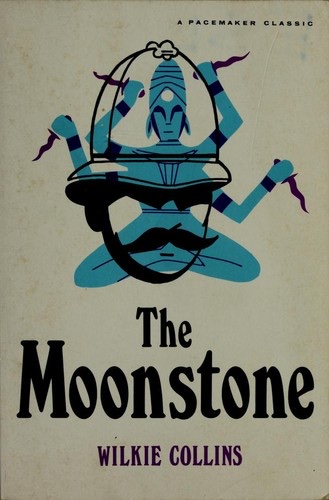
Cover of The Moonstone

The Moonstone

Wilkie Collins

4 ideas

  1. The sleepwalking thief who stole unknowingly

    On Rachel Verinder's birthday night, Franklin Blake was secretly dosed with laudanum by Dr. Candy, who wanted to punish his mockery of medicine. In an opium trance, and anxious about the diamond's safety, Blake took the Moonstone from Rachel's cabinet. He passed it to Godfrey Ablewhite, a respected philanthropist, who pawned it to cover his debts and was later murdered by the Hindu guardians, who restored the stone to their idol. Rachel saw Blake take it and kept silent out of love, and the investigation stalled for a year because the thief was the man most eager to find it.

  2. Truth assembled from partial testimonies

    The crime is told in a relay of first-person accounts: the house steward, a pious spinster, a lawyer, a doctor's assistant and others. Each narrator reports only what they witnessed, filtered through their own vanity, class and creed, so no single account contains the solution. The reader must treat every narrator as both evidence and a biased instrument, and correct each account against the others, to rebuild what happened.

  3. Solving by re-enacting the original conditions

    Ezra Jennings, Dr. Candy's assistant, solves the case by reconstruction rather than deduction. He recreates the room, the furniture, Blake's abstinence from tobacco and a matching dose of laudanum, and Blake repeats the taking of the object in his trance. The method holds that an unconscious act can be proven by reproducing the physiological and environmental conditions that produced it, since the actor cannot testify to it.

  4. Suspicion follows social expectation, not evidence

    Sergeant Cuff's reasoning is sound, but he fixes on the obvious suspects. These are Rosanna Spearman, a housemaid and former thief, and Rachel, whose secretive silence looks like guilt. Rosanna's hiding of a paint-smeared nightgown was in fact an act of love to shield Blake. The respectable gentlemen, one of them opium-dosed and one a charitable churchman, escape scrutiny because of their status. The book argues that investigators read behavior through class and character stereotypes, and so miss culprits whose standing makes them seem beyond suspicion.

Save and mark ideas in the app