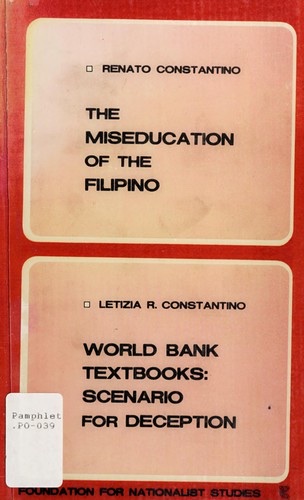
Cover of The Miseducation of the Filipino

The Miseducation of the Filipino

Renato Constantino

6 ideas

  1. Education as instrument of colonial pacification

    American colonial schooling was deployed not primarily to enlighten but to pacify: after military conquest, the classroom completed the subjugation by winning minds rather than territory. Teachers (the Thomasites) followed soldiers, and the curriculum's function was to make Filipinos accept American rule as benevolent and natural.

  2. Colonial mentality as manufactured self-contempt

    Colonial mentality is the internalized belief that the colonizer's culture, products, and judgments are superior and one's own are inferior. It is produced systematically when a people learns its history, heroes, and standards of excellence through the rulers' eyes, so admiration for the master and disdain for oneself persist long after formal independence.

  3. Foreign-language instruction impedes thought and unity

    Teaching through English forced students to spend their energy mastering a foreign medium instead of mastering ideas, producing rote memorization and shallow understanding. It also split society into an English-speaking elite and a vernacular-speaking majority, creating a barrier that separated the educated from their own people.

  4. Ask whose interests a curriculum serves

    Examine any educational system by asking which national and economic interests its content, heroes, and values actually serve rather than taking its stated goals at face value. Seen this way, American-centred textbooks that celebrated U.S. history and democracy trained Filipinos to be consumers and supporters of American interests rather than citizens pursuing their own.

  5. Colonial education produced economic dependency

    By emphasizing a taste for foreign goods and white-collar aspirations while neglecting national industrial needs, the schools reinforced the Philippines' role as an agricultural raw-material supplier and a market for American manufactures. The educated elite became agents of this dependency because their schooling aligned their tastes and ambitions with the metropole.

  6. Nationalist education as the corrective

    Rebuilding requires an education rooted in the nation's own needs: teaching in the national language, rewriting history from the colonized people's perspective, and orienting learning toward economic self-reliance and critical thinking. Nationalism here is not chauvinism but the conscious defense of national interests against continuing foreign domination.

Save and mark ideas in the app