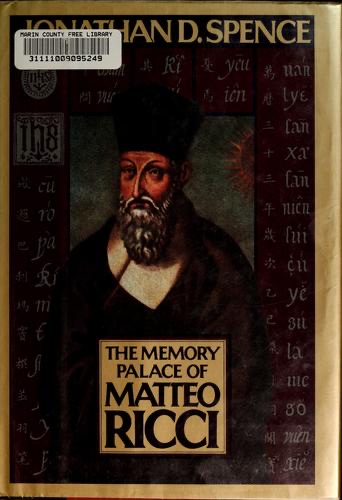
Cover of The Memory Palace of Matteo Ricci

The Memory Palace of Matteo Ricci

Jonathan Spence

4 ideas

  1. Ricci Teaches Memory Arts in Nanchang

    In 1596 the Jesuit Matteo Ricci, living in Nanchang, wrote a Chinese treatise on mnemonics, the Xiguo jifa, for the provincial governor Lu Wangai and his sons, who were preparing for the civil-service examinations. He offered them the European memory palace as a tool for mastering the classics, and presented four sample images built on Chinese characters, including warriors grappling for 'war' and a reaper in a field for 'profit.' The scholars admired the technique as a feat of learning, but it did not become the path to conversion Ricci had hoped for.

  2. The Memory Palace as Architecture

    The memory palace is a building constructed in the imagination. It can be real, invented, or a mix, and each room and corner is a fixed location. Things to be remembered are turned into vivid, often grotesque or emotionally charged images and placed in those locations in a set order, so walking the building in the mind retrieves them in sequence. Its capacity grows by adding rooms and buildings, which turns memory from rote repetition into spatial organization.

  3. Admired Techniques Rarely Carry Their Message

    Ricci tried to win Chinese literati by displaying Western skills: prodigious memory, world maps, clocks, mathematics. He dressed and argued as a Confucian scholar so that the faith would ride in with the prestige of the learning.

  4. Organizing History Through Its Subject's Images

    The book takes four memory images and four religious pictures that Ricci himself made or used, including the Christ-walking-on-water print given to the inkmaker Cheng Dayue, and treats each as a room from which a chapter opens. The images become the organizing structure rather than illustrations. The chapters move outward into Counter-Reformation Europe, Mediterranean wars, and Ming society. Using a historical figure's own mental apparatus as the frame reconstructs how that person connected ideas, not just what happened to him.

Save and mark ideas in the app