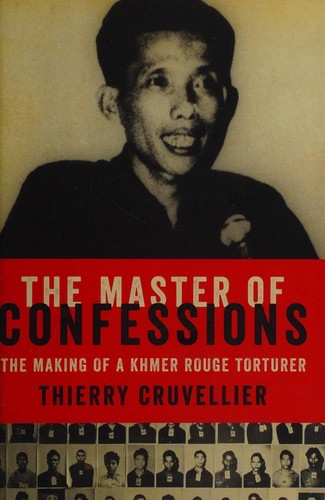
Cover of The Master of Confessions

The Master of Confessions

Thierry Cruvellier

4 ideas

  1. Duch's confession undone on the final day

    In 2009 Kaing Guek Eav (Duch), the former mathematics teacher who ran the S-21 prison where at least 12,000 people were interrogated, tortured and executed, stood trial at the UN-backed Khmer Rouge tribunal. For months he acknowledged responsibility, apologised to victims and cooperated in detail, in line with his French lawyer François Roux's strategy of confession. Then in closing arguments his Cambodian lawyer Kar Savuth, followed by Duch himself, asked for acquittal and release on the grounds that he was not a senior leader, which threw his remorse into doubt. He was sentenced in 2010 to 35 years, and the sentence was raised to life on appeal in 2012.

  2. Confession as a continuation of control

    A perpetrator whose job was extracting confessions can use his own confession as another instrument of mastery. He accepts responsibility in broad, structural terms while fighting over specific details, such as whether he personally killed or who ordered what. He corrects witnesses and lectures the court. The act of admitting lets him set the narrative, the vocabulary and the level of precision, so confessing becomes a way of keeping authority over the story rather than giving it up.

  3. The perpetrator as the crime's expert

    When the evidence of an atrocity is a bureaucratic archive the perpetrator built himself, such as annotated confessions, execution lists and photographs, the court has to rely on him to interpret it. His expertise makes him the most informed person in the courtroom. Victims and survivors, by contrast, know only fragments. This reverses the usual hierarchy of testimony, and the accused becomes the historian of his own crime.

  4. Legal incentives make remorse unverifiable

    A trial asks the accused both to acknowledge guilt and to show sincere contrition. But admitting guilt can also reduce a sentence, so every sign of remorse can be read as strategy. The adversarial system gives the defendant reasons both to confess and to deny, and he may do both, as in a mixed confession-and-acquittal defence. The result is that the court cannot tell whether the moral transformation victims want from him has actually happened.

Save and mark ideas in the app