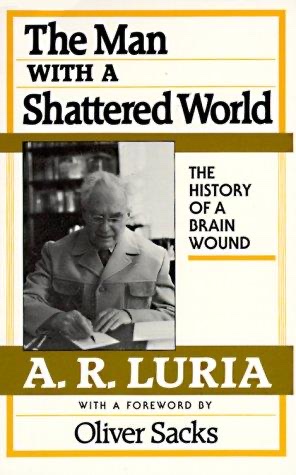
Cover of The Man with a Shattered World

The Man with a Shattered World

A. R. Luria

4 ideas

  1. Zasetsky's twenty-five-year diary after a head wound

    In March 1943 at Smolensk, Lev Zasetsky, a young Soviet lieutenant, was shot through the left parieto-occipital region of the brain. He was left with a fragmented visual field, a disordered sense of his own body, and memory that returned only in scraps. For about twenty-five years he wrote a diary, eventually some 3,000 pages and sometimes managing only a line or a page a day, piecing together his past and his condition from fragments he could no longer hold in mind at once.

  2. Grammar of relations as spatial synthesis

    The parieto-occipital cortex binds separate items into a single simultaneous whole, and this same operation underlies grasping logical-grammatical relations. When it is damaged, a person can still understand isolated words but cannot resolve constructions like 'father's brother' versus 'brother's father,' or 'Is an elephant bigger than a fly?' Relational meaning is structurally a spatial problem, so losing spatial synthesis takes quasi-spatial grammar with it.

  3. Spared motor skill routes around damaged thought

    Zasetsky could barely read or retrieve words deliberately, yet he could write fluently if he kept the pen moving without lifting it, drawing on writing as an automatized 'kinetic melody' stored in intact motor systems. Recovery happens by reorganizing a function through preserved pathways, not by restoring the damaged one. Rehabilitation should therefore find the spared route and load the task onto it.

  4. Romantic science: the whole person as data

    Classical science breaks a phenomenon into elements and abstract laws, and in doing so loses the living person. Luria's 'romantic science' keeps the full individual in view by combining precise neurological analysis with the patient's own account of what the deficit is like to live with. On this view, a single deeply documented case can reveal how a mental system is organized more clearly than aggregated statistics can.

Save and mark ideas in the app