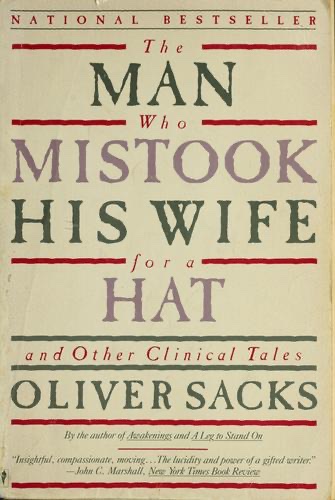
Cover of The Man Who Mistook His Wife for a Hat

The Man Who Mistook His Wife for a Hat

Oliver Sacks

5 ideas

  1. Jimmie G., the mariner stuck in 1945

    Jimmie G., a former Navy radio operator with Korsakoff's syndrome from alcohol damage, believed it was 1945 and that he was 19. He met Sacks as a stranger every few minutes and was shocked by his own aged face in a mirror, then forgot the shock. He had lost the ability to form new memories, but he became absorbed and whole during Mass, in music, and in gardening, which suggested that a self can be held together by attention and meaning even when continuous memory is gone.

  2. Dr. P., who mistook his wife for a hat

    Dr. P. was a gifted music teacher with visual agnosia. He could describe the parts of objects abstractly but could not recognize them as wholes. He described a glove as 'a continuous surface, infolded on itself' with five outpouchings, and he reached for his wife's head, taking it for his hat. He managed daily life by singing through his routines, which suggests that when one faculty fails, another intact one such as music can take over the job of organizing action.

  3. Proprioception as the invisible sixth sense

    Proprioception is the continuous, unconscious feedback from muscles and joints that tells us where our body is and that it belongs to us. In the case of Christina, a sensory neuropathy destroyed this sense, and she felt 'disembodied.' She relearned to move by watching her limbs and controlling them visually, with constant effort. Her case shows that the felt sense of owning a body is an ongoing construction by a specific sense, not a given.

  4. Deficits and excesses reveal the brain

    Sacks divides disorders into losses (deficits), such as agnosia and amnesia, and excesses, such as Tourette's tics, manic 'wit,' and reminiscence seizures. The excesses can feel to the patient like gifts they don't want to lose. Asking what a disorder adds, and not only what it takes away, shows that the same pathology can be both an affliction and a part of personality.

  5. Case histories must restore the person

    Sacks argues that the standard clinical case history records a disease but erases the subject: the person who is struggling with, adapting to, and making meaning of the condition. He proposes a 'neurology of identity' written as narrative, because a life is lived as a story. The patient's response to the damage is itself clinical data, not decoration.

Save and mark ideas in the app