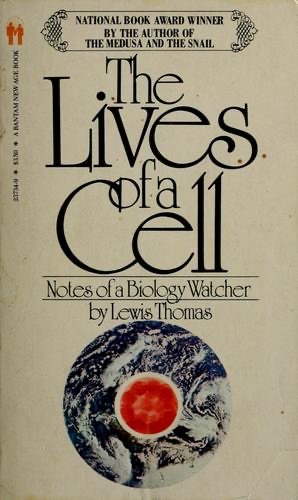
Cover of The Lives of a Cell: Notes of a Biology Watcher

The Lives of a Cell: Notes of a Biology Watcher

Lewis Thomas

5 ideas

  1. Three levels of medical technology

    Thomas sorts medical technology into three levels. 'Nontechnology' supports patients with poorly understood diseases without touching the underlying mechanism. 'Halfway technology' compensates for disease or postpones death, while 'high technology' comes from understanding the disease's mechanism and can cure it, and he argues that once found it outweighs the cost of the research, so basic research should get funding priority.

  2. Myxotricha paradoxa as a composite organism

    In 'An Earnest Proposal' Thomas points to Myxotricha paradoxa, a protozoan living in the digestive tract of Australian termites. It is only partly understood, and he suggests that fuller study could make it a model for how our own cells developed through cooperating organisms. He proposes, half-seriously, that no one should be allowed to fire nuclear weapons until humans can explain this one living thing completely.

  3. The body as an inherited collective

    Thomas argues that our bodies are not entirely our own, because mitochondria and other organelles descend from once-separate organisms that now live inside our cells. From there he builds an exploratory metaphor of the Earth as a single giant cell, with humans as one part of a vast interdependent system rather than its masters.

  4. Decontaminating astronauts as human chauvinism

    Thomas argues that quarantining returning astronauts reflects 'human chauvinism.' His reasoning is that organisms on Earth are mostly symbiotic, and even harmful ones have co-adapted with their hosts through long association. On that view, a stray microbe from the Moon would lack this adaptation and so is unlikely to be equipped to harm Earth life.

  5. Societies functioning as a single organism

    Thomas observes that some animals in large groups, such as termites, slime molds, schooling fish and flocking birds, behave collectively like one larger organism. He suggests humans resist the ant comparison out of pride. He argues that science fits the model, because scientists communicate results and build on one another's work, so the enterprise advances collectively into the unknown.

Save and mark ideas in the app