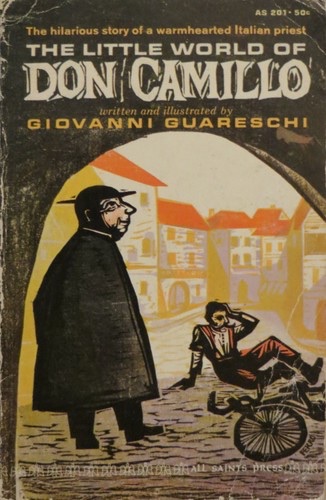
Cover of The Little World of Don Camillo

The Little World of Don Camillo

Giovannino Guareschi

4 ideas

  1. The baptism of Lenin Libero Antonio

    Peppone, the Communist mayor, brings his newborn son to church and demands he be baptized 'Lenin Libero Antonio'; Don Camillo refuses, and the two come to blows before the priest wins and the child is christened with a saint's name. The episode shows a man who publicly rejects the Church but still insists on its sacraments for his own child, so that the ideological quarrel is fought out inside a shared ritual rather than outside it.

  2. Conscience as dialogue with a voice

    Don Camillo's moral reasoning is staged as argument with the crucified Christ, who rebukes his vanity, forbids his revenge, and mocks his self-justifications. Making the conscience an outside voice that talks back turns private rationalization into a visible negotiation, where the reader can see exactly which excuses the self offers and why they fail.

  3. Shared place outweighs opposing ideologies

    The priest and the Communist mayor are sworn enemies on doctrine, yet they cooperate whenever the village itself is threatened, such as by floods or real hardship, because both belong to the same land, river, and people. The book argues that local, physical belonging and a history of personal acquaintance run deeper than party or creed, so rivals of the same place stay bound to each other.

  4. Rivalry with an unwritten code of honor

    Don Camillo and Peppone trick, insult, and even fight each other, but they keep unspoken limits: neither destroys the other, betrays him to outside authorities, or humiliates him past repair. Because the conflict is bounded by mutual respect, it becomes a working relationship in which open hostility and real loyalty exist side by side.

Save and mark ideas in the app