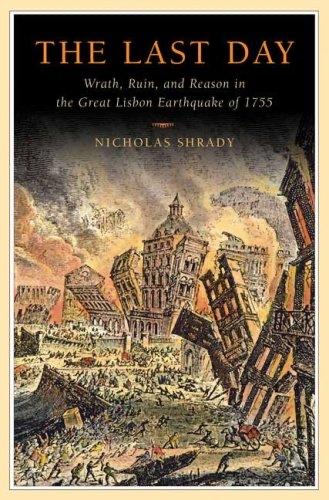
Cover of The Last Day

The Last Day

Nicholas Shrady

4 ideas

  1. Lisbon destroyed on All Saints' Day 1755

    On the morning of 1 November 1755, a feast day when much of Lisbon was at Mass, a powerful earthquake brought down churches and houses. Survivors fled to the open ground by the Tagus waterfront, and a tsunami then swept over them, while fires, commonly attributed to overturned altar candles and hearths, burned for days. Tens of thousands died and much of one of Europe's richest capitals was destroyed.

  2. Secular crisis management displaced providential interpretation

    The future Marquis of Pombal took control through practical measures: rapid burial of the dead, including disposal at sea, food distribution, price controls, and gallows for looters. This set state administration against clergy such as the Jesuit Gabriel Malagrida, who preached that the quake was divine punishment demanding penance. Pombal's rivalry with the Jesuits ended with Malagrida's execution in 1761, showing how a disaster can shift authority from the church to a centralizing state.

  3. Pombaline reconstruction and the anti-seismic cage

    The Baixa was rebuilt as a planned grid of standardized buildings. They used the gaiola, a flexible timber lattice inside masonry walls that holds the structure together when the ground shakes, reportedly tested by having troops march around models. Pombal also sent parishes a standard questionnaire about the quake's duration, aftershocks, water levels and damage, which made the disaster a subject of systematic inquiry rather than only mourning.

  4. Disaster as a test of theodicy

    Lisbon undermined the optimism of Leibniz and Pope, the view that 'whatever is, is right', because the quake struck worshippers and sinners alike on a holy day. Voltaire's poem on the disaster and his novel Candide attacked providential explanations. Rousseau replied that the suffering was human-made, since people had crowded into tall houses, and Kant wrote naturalistic accounts of earthquake causes, turning a natural event into an argument about how to explain evil.

Save and mark ideas in the app