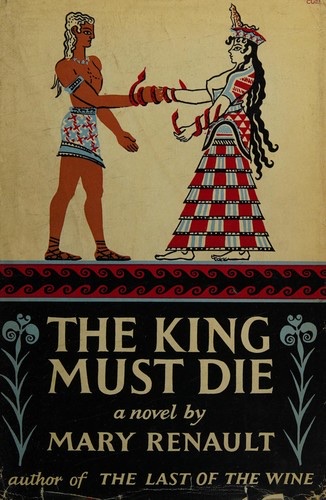
Cover of The King Must Die

The King Must Die

Mary Renault

4 ideas

  1. Theseus overturns the Eleusinian year-king

    At Eleusis, a matriarchal custom made a man king for one year, after which he was killed by his successor in ritual combat, while the Queen held real power. Theseus kills the reigning king and inherits the role. Rather than wait for his own death, he uses the Eleusinian men's resentment of female rule to break the annual sacrifice and turn a ceremonial victim-king into a ruling one.

  2. Kingship as willing sacrificial consent

    The king's legitimacy rests on his readiness to die for the land when the god requires it, as the book's title says. This readiness is what separates a king from a mere ruler with power. The obligation is internalized rather than imposed: Theseus accepts the possibility of his own sacrifice as the price of authority, and that acceptance gives him standing with his people.

  3. Bull-dancers as a trained team

    In Renault's Knossos, the Athenian tribute youths are not simply fed to a monster. They are trained in a school to leap and dance with bulls as professional performers in the palace arena. Theseus survives by forging his team of young men and women into a disciplined unit bound by mutual loyalty, so that each protects the others in the ring. Over time the team becomes the base of the power he uses against the Minoan palace.

  4. Myth read as distorted historical memory

    The novel treats the legends of the Minotaur, the Labyrinth, and the tribute as later misremembered versions of real Bronze Age institutions, politics, and events. Examples are the palace called the Labyrinth, the bull-sport, and dynastic intrigue. Divine intervention is reduced to what the characters believe, so outcomes are explained by human choice, custom, and natural events such as earthquakes. This lets the reader see a myth as evidence about the society that produced it.

Save and mark ideas in the app