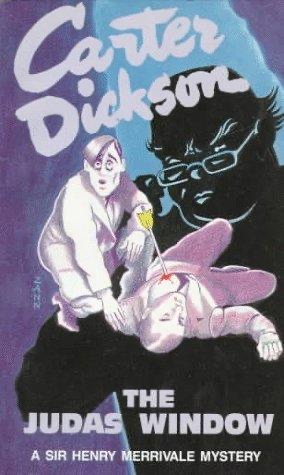
Cover of The Judas Window

The Judas Window

John Dickson Carr

4 ideas

  1. Answell's trial for the bolted-room arrow killing

    James Answell visits Avory Hume, the father of his fiancée, and wakes in Hume's bolted, shuttered study to find Hume stabbed with an arrow bearing Answell's fingerprints. Answell says he was drugged by a whisky he was served, and the only two people in a sealed room make his guilt look arithmetically certain. At his Old Bailey trial, Sir Henry Merrivale defends him by showing that the room was never truly sealed and the scene was staged to frame him.

  2. Every room has a Judas window

    A 'Judas window' is a small opening that lets someone see or reach through a barrier that looks solid. The novel's opening is the hole left when a doorknob and its square spindle are removed from a bolted door. Such an opening exists in almost every ordinary door, so a room can be bolted from the inside yet still be reachable from outside through hardware nobody thinks to inspect.

  3. Impossibility means a flawed premise, not magic

    When a crime looks impossible, the productive question is which unexamined assumption makes it seem so, not how the impossible happened. Merrivale takes apart the 'sealed room' by questioning what 'sealed' actually meant physically. The contradiction dissolves once one taken-for-granted fact about the door turns out to be false.

  4. Overwhelming circumstantial evidence can be manufactured

    The more perfectly the evidence points to one person, the more seriously investigators should consider that someone arranged it. Answell's fingerprints on the weapon, his presence alone with the body and the bolted door are each damning. Together they form too neat a picture, and a drugged man cannot rebut it alone. The novel argues that a legal system which treats coherence as proof will convict the framed.

Save and mark ideas in the app